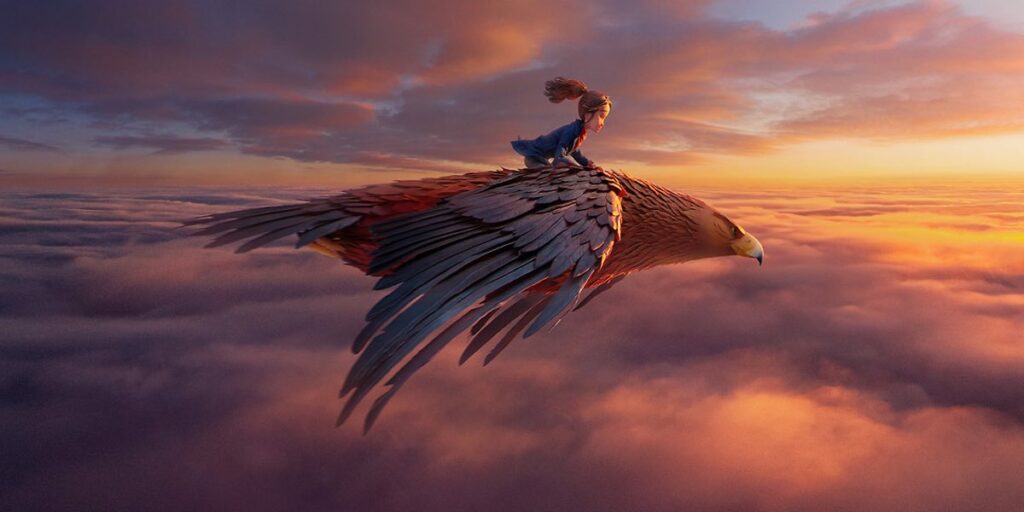
While none of Laika’s films have crossed $200 million at the worldwide box office, none of them needed to. As the son of Nike co-founder Phil Knight, Laika CEO Travis Knight has the freedom to do precisely what he wants: labor over acclaimed stop-motion productions (from “Coraline” to “Kubo and the Two Strings”) in his Hillsboro studio.
Look no further for proof than “Wildwood,” which is set in a parallel Portland and took more than seven years to film. Based on the children’s fantasy novel by Decemberists bandleader Colin Meloy, the film adapts the illustration style of Meloy’s wife, Carson Ellis, leading to the most lifelike evolution yet of the Laika house style.
That evolution manifests in part with the studio’s first PG-13 rating—which is striking, since their previous films pushed the PG envelope with psychological terror and mature humor (and not just ribaldry like the “Coraline” burlesque sequence.)
The prologue of “Wildwood” alone justifies the stronger rating. A young boy steps out, completely naked, on a rain-lashed balcony, tears a clockwork gear from his chest, and plummets to his death in front of his mother: the Dowager Governess (Carey Mulligan), a tragic antagonist who clings to grief.
As the turbulent tale unfolds, blood—human and otherwise—flows through the story of Prue (Peyton Elizabeth Lee) and Curtis (Jacob Tremblay) chasing down a murder of crows that abducted Prue’s baby brother, Mac (Arthur Knight, son of Travis). It all builds to an epic medieval battle with burning trebuchet bombs, lethally creeping ivy, and dying soldiers on all sides.
To realize Meloy’s alternate Portland, Laika exquisitely replicates local landmarks (ranging from St. Johns to Waterfront Park in full cherry blossom glory). And when Prue and Curtis journey to the Impassable Wilderness west of the city, they not only get to see Pittock Mansion, but several other natural wonders from all across the state: the Columbia Gorge, the Painted Hills, Haystack Rock.
Though it’s unlikely that Laika will adapt the remaining two books in Meloy’s trilogy, this story is very much satisfactory as a standalone piece, while also serving as a bridge to a potential future era of even greater maturity for the studio. In fact, their next film is an adaptation of the even less child-oriented Susanna Clarke novel “Piranesi.”
A mythologically inspired mystery rife with abusive antagonists and unsettlingly surreal environs, “Piranesi” will present Laika with new aesthetic and narrative challenges. And like “Wildwood,” it will likely be made precisely the way Knight wants to make it.