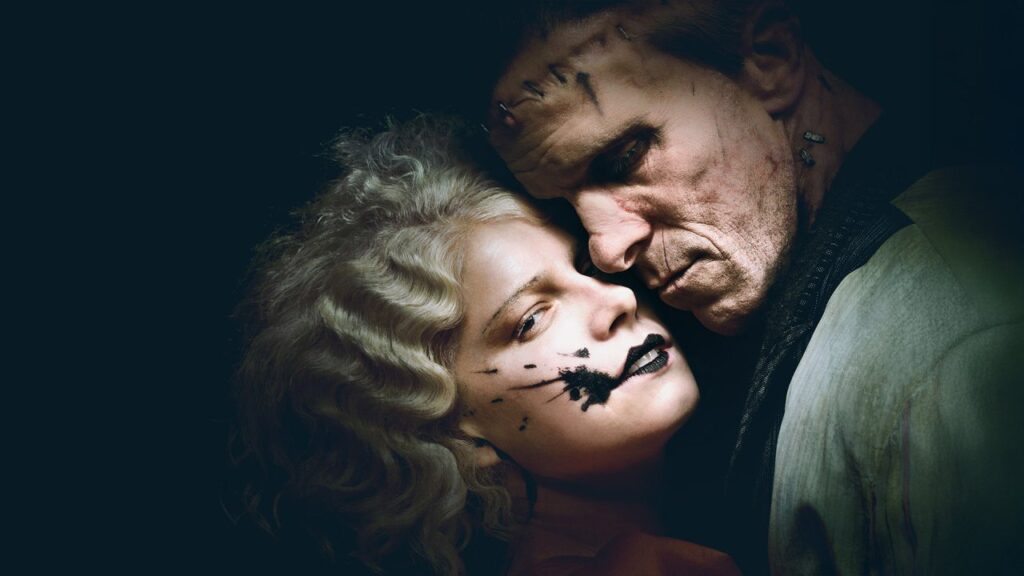
Mary Shelley’s “Frankenstein” is not only a genre-exploding work of science-fiction, but an icon of Hollywood’s golden age. Yet throughout its many adaptations and reinterpretations, precious few have been from a woman’s perspective (despite the story being about a power held exclusively by mothers: the creation of life).
The promise of filling that blindspot is what excited me about Maggie Gyllenhaal’s “The Bride!” What I didn’t expect, however, was an anarchic clusterfuck of style and tone, veering from gothic romance to gangster melodrama to post-modern feminist manifesto. The film is wild, unfocused, and utterly chaotic—and it may end up being one of my favorite movies of the year.
“The Bride!” begins in Chicago, circa 1936, where Dr. Frankenstein’s monster (Christian Bale) asks Dr. Euphronious (Annette Bening) to alleviate his loneliness by building him a bride. Reluctantly, she agrees and revivifies Ida (Jessie Buckley), a recently deceased escort, to be Frank’s paramour.
Before long, the undead couple are on the wrong end of an angry mob and being pursued cross-country by an intrepid gumshoe (Peter Sarsgaard, who is married to Gyllenhaal) and his savvy counterpart (Penélope Cruz). It’s a kaleidoscopic narrative fusing countless genres: horror, film noir, and even musicals.
The original “Bride of Frankenstein” (1935) opens with Mary Shelley (Elsa Lanchester, who also plays the Monster’s Mate) telling the story of the movie to her fellow Romantics. Yet in Gyllenhaal’s film, it is Shelley’s ghost (also played by Buckley) who becomes a character in the story, possessing Ida and forcing her participation in the narrative.
Playing a dual role allows Buckley (fresh from her Oscar-winning work in Chloé Zhao’s “Hamnet”) to flourish, persuasively embodying both an erudite, foul-mouthed Brit and a streetwise call girl. Her performance reinforces one of the core themes of “Frankenstein”: that of the creation rebelling against the creator.
In Gyllenhaal’s revision, Ida never wanted to be the Bride and never wanted to go on the run, but Shelley’s need to tell the story transcends the boundaries of mortality and fiction itself. Owning her status as a main character is the final challenge Ida needs to overcome in order to reclaim any semblance of control as she hurtles toward the afterlife (for real this time).
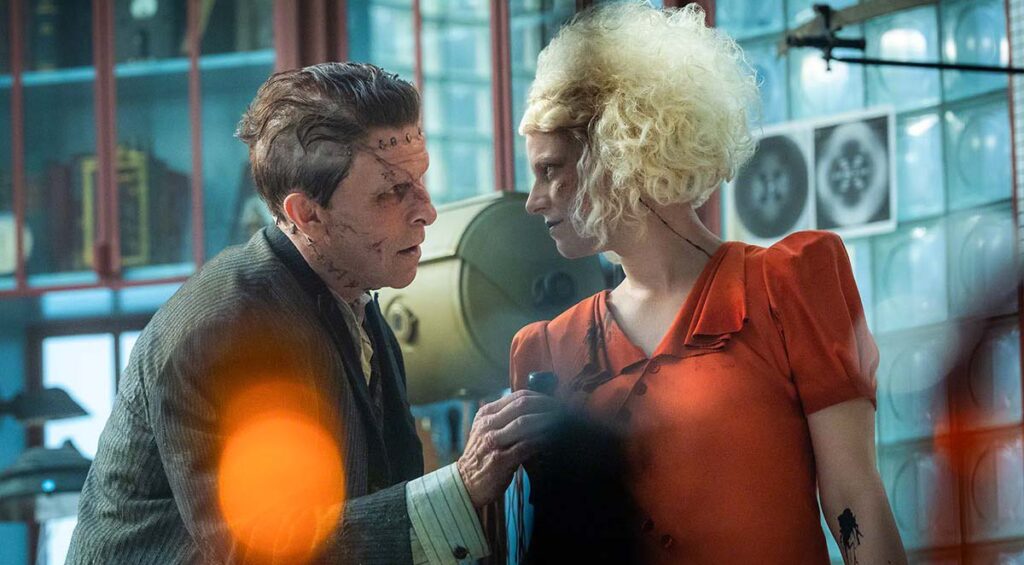
Frankenstein, who goes by Frank, has his own complex relationship with fiction. Despite being over 100 years old, he is literally dying of loneliness—and during bouts of stress and anguish, his only salve is indulging his passion for Ronnie Reed (Maggie’s little brother, Jake), a Fred Astaire-esque musical star.
Frank is at his most content while watching Ronnie’s films, imagining himself dancing on the silver screen in Ronnie’s custom tap shoes (he’s inspired not only by his hero’s talent, but by the fact that he overcame polio). That makes it all the more wrenching when Frank meets Ronnie in New York, pouring his heart out to his idol only to be callously rejected.
The resulting heartbreak is so overpowering that it kicks off probably the wildest moment in the film: a spontaneous musical number where Frank and Ida lead a choreographed dance set to Irving Berlin’s “Puttin’ On the Ritz” (presumably because Maggie Gyllenhaal recognizes that with 1974’s “Young Frankenstein,” Mel Brooks did just as much for the character’s cinematic legacy as, say, James Whale or Terence Fisher.)
Like Shelley’s connection to Ida, Frank and Ronnie’s relationship enters the realm of metafiction. Films give Frank a sense of belonging—and when that illusion is shattered by Ronnie’s cruelty, Frank’s operatic despair drags movie magic into the real world, further blurring the line between fact and fiction.
As Ida and Frank’s blossoming romance is repeatedly interrupted by sexual predators, the film’s righteous anger gathers force, while remaining grounded in the lived (and un-lived) experiences of its heroine. Ida may emerge as the accidental figurehead of a punk-feminist revolution, but the uprising unfolds in the background of her quest for an identity.
Ida’s resistance to the patriarchy is encapsulated by the repeated line “I would prefer not to,” a reference to the eternal refrain from Herman Melville’s short story “Bartleby, the Scrivener.” While Bartleby’s usage of the phrase underlined his tragic passivity, Ida reappropriates it as a statement of defiance, rejecting the roles she’s been forced into and carving out space for her and Frank to love and exist on their own terms.
In that respect, the couple are not unlike Gyllenhaal, who has carved a “The Bride!”-shaped hole in Hollywood. Her creation may be a mess of a movie, but it is held together by her commitment to reinventing an old myth as a symbol of contemporary rage that earns the film’s advertisement for itself: “For never was there a story so fine/As that of The Bride—and her Frankenstein.”