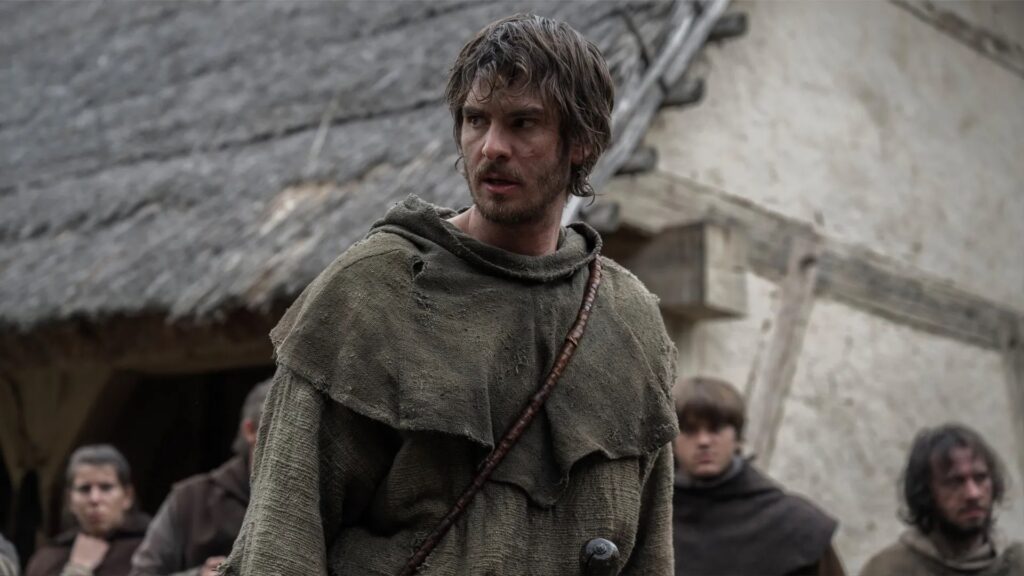
Andrew Garfield really wants the billionaires to have a bathroom emergency—and between playing the Ploughman in “The Uprising” and OpenAI CEO Sam Altman in “Artificial,” he’s landing a real number-one, number-two punch. (“Artificial,” which was dropped by Amazon and picked up by Neon, will be released on Christmas Day.)
Before Garfield’s latest tech-bro turn (he also played Eduardo Saverin in “The Social Network”), “The Uprising,” written and directed by Paul Greengrass (the “Bourne” films), whisks him into a swath of British history that even moviegoers who scored a five on the AP Euro exam probably forgot: the Peasants’ Revolt of 1381.
“The truth of that period of time,” Garfield explained in a recent interview with Esquire, “was that there were brutal conditions for working-class people, brutal taxation post-plague, incompetence in government, abusive practices, with the underclass being seen as sub-human creatures from the perspective of those in power.” Sound familiar?
As COVID-19 deaths continue and too many seek to crown themselves kings, there’s contemporary resonance to be found in the tale of Garfield’s anonymous Ploughman (a widower who lost his family to the Black Plague) struggling to maintain a tiny plot of infertile land—and reacting violently when King Richard II’s tax men come around, hands held out in avarice.
(In addition to demanding payment as proof of death for the Ploughman’s family, the king’s soldiers also forcibly check under young women’s skirts to determine their adulthood and taxability, an indignity not visited on any male character in sight.)
While Garfield plays a fictionalized everyman, actual historical figures from the Peasants’ Revolt are represented in the film. Jamie Bell plays John Ball, a priest who was defrocked and imprisoned as a heretic for preaching in support of the peasantry, and Cosmo Jarvis (“Shōgun”) appears as Wat Tyler, a former soldier often cited in history books as the leader of the rebellion.
It’s worth noting that by briefly billing “The Uprising” as a Robin Hood origin story, Focus Features’ marketing campaign diminished the film’s historical weight. Genericizing the story (or, more likely, watering it down for Americans), serves neither the film nor its viewers (especially after critics and audiences rejected Michael Sarnoski’s miserable “The Death of Robin Hood” earlier this year).
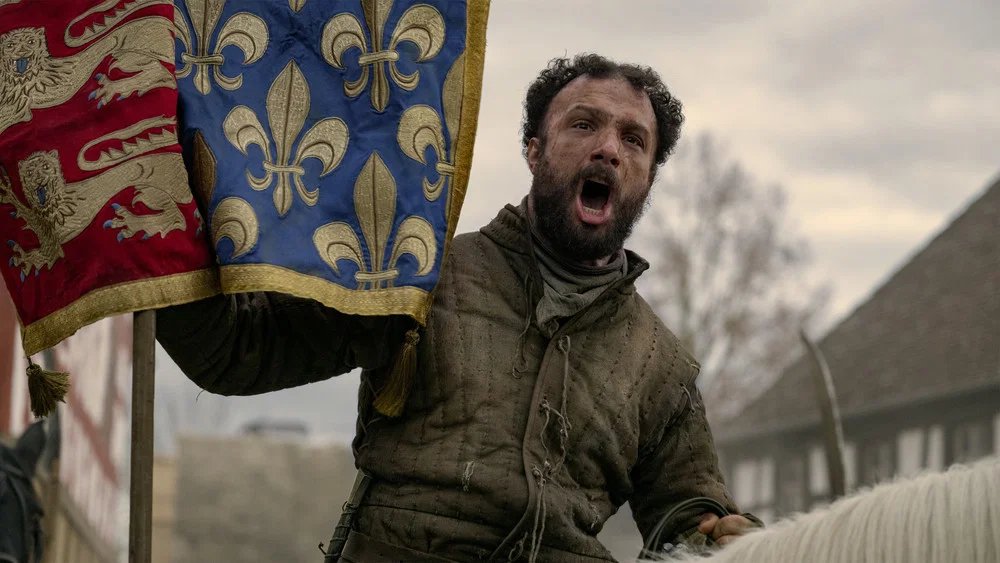
That said, there are some Robin Hood archetypes among the characters of “The Uprising.” The righteously angry Ball can be our Friar Tuck; Tyler our Little John; and Alice (Thomasin McKenzie), a former nun forged by trauma, our Marian.
While it’s harder to find an equivalent of the Sheriff of Nottingham, the council looming over Richard (Woody Norman), the boy king, collectively fills that role. Leveraging Richard’s youth and mental torment, they enact the very policies that drive the commoners to rise up against him—all to avoid taxing the merchant class (lest they demand a seat at the table).
On that note: When the uprising reaches London, the rebels attack and kill merchants not because of their stature, but because of their nationality. Specifically, they target Flemish merchants, reflecting the immortality of xenophobia throughout history and complicating any attempt to perceive the rebels (who are referred to as “deplorables”) purely as noble champions of the oppressed.
Through it all, Greengrass relies on his usual raggedy, vérité storytelling (a remnant from his past life as a documentary filmmaker for British television’s World in Action). His visual style is arguably too modern for this story, but his script effectively explains class division in a language that today’s audiences can understand, making the attempted insertions of Robin Hood marketing all the more silly in comparison.
Unfortunately, those insertions extend to the film’s epilogue, which depicts a good-sized army of common folk dressed in dirty green, ready to fight. Up to that point, the movie hasn’t been one to hold the viewer’s hand, but the tacked-on, dragged-out ending comes across as overly literal.
In true British tradition, the cast is the movie’s saving grace. Garfield tops the bill as ably as ever, but Bell is as an even greater standout, showing how faith exhorts people of the countryside to take action (Ball times his campaign to match with holy days, so as to underscore how God has given them their mission).
Katherine Waterston also makes a strong impression as Richard’s mother, Joan of Kent. Her pale face, framed in elaborate finery, beautifully expresses Joan’s horror at her callow son’s barbarism—and reminds us that when it comes to class division, there’s nothing new under the sun, whichever empire it sets over.