
Until now, James Cameron’s “Avatar” films have begun with the camera skating over lush treetops (look at it go!) and ended with Jake Sully (Sam Worthington) opening his eyes to the beat of the late James Horner’s percussion-and-choir signoff (bahm-bah!).
Those rituals, however, are history in “Avatar: Fire and Ash,” which opens with two brothers in flight and closes with a cosmic flourish. Perhaps that’s because Cameron has outgrown the first film’s primal, irresistible premise: a journey to the distant moon of Pandora expands a disabled marine’s soul (and adrenal glands).
“End of an era,” announces Miles Quaritch (Stephen Lang), a rapacious colonel in an army of Earth-born colonists (known to Pandora’s indigenous Na’vi as “the sky people”). The question is: Whose? Is “Fire and Ash” the end of an era for “Avatar”? For Cameron’s sweeping, storied career? For the world?
While I’m still wrapping my sky-person brain around the movie’s Na’vi melodrama, I think I can safely say: all of the above. “Fire and Ash” may be an “Avatar” sequel, but it is also a cinematic cousin of Cameron’s “The Abyss” (1989), an underwater voyage that confronted (and nearly drowned in) divine endlessness.
“It was like a dance of light,” says Lindsay Brigman (Mary Elizabeth Mastrantonio) after beholding a hunk of glowing biotechnology in “The Abyss.” I can’t think of a better summation of “Fire and Ash,” a dance of light with so many moves that it leaves you at once ecstatic and exhausted.
Weariness has already set in by the time “Fire and Ash” begins surveying the shattered emotional pieces of “Avatar: The Way of Water” (2022)—notably the slaying of Neteyam (Jamie Flatters), Jake’s eldest son, at the hands of Quaritch’s crude lackeys.
“I killed my brother,” declares Lo’ak (Britain Dalton), who led the rescue mission that ended in Neteyam’s death. That’s a lot of weight on Lo’ak’s slender shoulders and on the movie itself, which is burdened and enriched by the tragedies and victories of the first two installments.
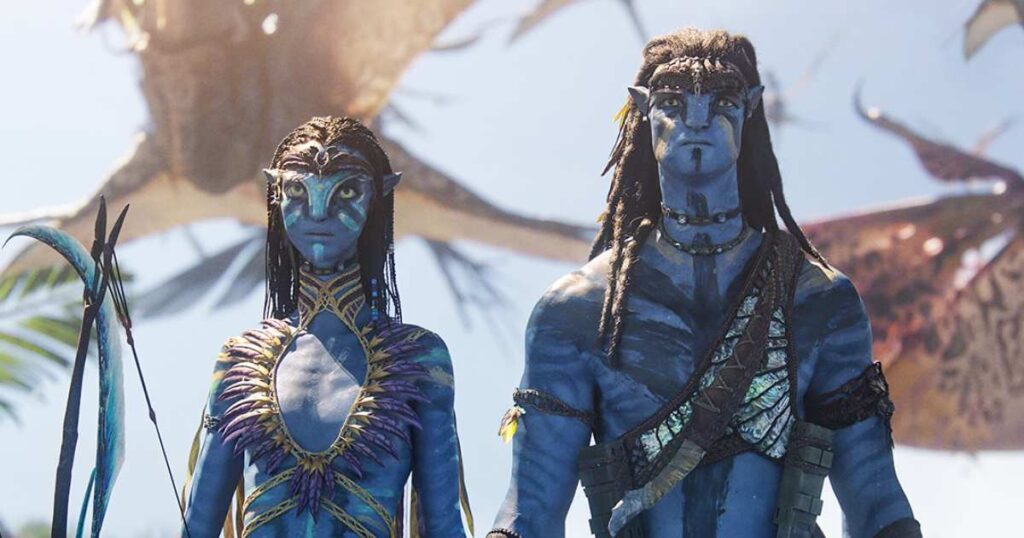
Released in 2009, the original “Avatar” pursued Jake into the jungles of Pandora, where he escaped the bonds of his paralyzed body by projecting his consciousness into a Na’vi avatar: blue-skinned, 8′ 11″, and highly attractive to Neytiri (Zoe Saldaña), the daughter of a Na’vi chief.
“Everything is backwards now,” Jake said during a brief return to his human form. “Like out there is the true world and in here is the dream.” Nevertheless, the dream was made corporeal by a far-out denouement: Jake being permanently transferred into his avatar, allowing him to build a family with Neytiri and forsake his dangerously desperate human kin.
“Earth is dying,” General Ardmore (Edie Falco) revealed in “The Way of Water.” “Our task here is to tame this frontier. Nothing less than to make Pandora the new home for humanity.” Inevitably, the taming escalates brutally in “Fire and Ash,” due to the demented leadership of Quaritch and Varang (Oona Chaplin), a Na’vi demagogue disturbingly simpatico with the human invaders.
“Show me how to make thunder!” Varang (rhymes with “wrong”) demands, lusting after the steel and guns that other Na’vi disdain. In temperament and tenacity, she is the answer to anyone asking whether Cameron’s paeans to indigenous virtue lean toward condescension—a character created to suggest that no culture has a monopoly on conquest (or cruelty).
As Varang, Chaplin moves with slithery, seductive grace (like most of the cast, she inhabits her digitally manifested character through a process called performance capture). You see enough of her that you want to see more, especially when Cameron is sprinting after the omni-present Spider (Jack Champion), a punkish human boy who has long yearned to be accepted by the Sullys.
“No shit!” Spider exclaims as he is finally embraced as a Na’vi tribesman in “Fire and Ash.” I get what Cameron is saying—that a human need not literally become a Na’vi, like Jake, to take up their cause—but I prefer his films when they have the sting of tragedy (Arnold’s fiery sacrifice in “Terminator 2,” Leo’s final plunge in “Titanic”), not the ease of wish fulfillment.
Of course, it all depends on which wish is being fulfilled. After a zigzag-y first act, “Fire and Ash” settles in for a gloriously linear assault on the industrial metropolis Bridgehead City, echoing the triumphant destruction of a terrorist’s Florida Keys stronghold in Cameron’s “True Lies” (1994).
“The People say that when you touch steel, its poison seeps into your heart,” Lo’ak warns. Still, it’s a kick to watch Bridgehead felled by Neytiri’s arrows, Spider’s shenanigans, and a bulldozer driven by Ian Garvin (Jemaine Clement, who spits out the movie’s best line with relish: “Is my protest noted now, fuckers?”).
Amid this addictive pandemonium lies the central contradiction of “Avatar”: The films preach protecting all of creation as they salivate over mass destruction, a dissonance that The New Yorker’s Anthony Lane once framed as a showdown between “Cameron’s two strains—the vegan who wants to plumb the mysteries of nature, and the hard-core weapons guy.”
“It’s as if Sir David Attenborough divided his time between birds of paradise and monster trucks,” Lane wrote. I have to ask: Is that such a bad thing? Or is the fact that Cameron is able to marvel at a bird of paradise and rev up a monster truck what makes him an artist of passion, friction, and consequence?
When it comes to Cameron’s films, part of the thrill is that for all their narrative slickness, they dare to ask questions too big for him to answer. It’s a tradition dating back to “The Terminator” (1984), which ends with Sarah Connor (Linda Hamilton) pondering predestination in alluringly unresolved terms.
“God, a person could go crazy thinking about this,” Sarah says into a voice recorder. Forty-one years later, Cameron is still eager to go a little crazy, as evidenced by a climactic encounter in “Fire and Ash” with Eywa, a maternal deity who has a gargantuan pale eye (like a benevolent Sauron).
A watchful (if rarely seen) lunar babysitter, Eywa can unleash the wrath of Pandora’s flora and fauna (Mother Nature kicks ass!). She’s deus ex Eywa, complete with monumental powers of persuasion—over Jake and, possibly, Quaritch, who now has a Na’vi body of his own.
“You got new eyes, Colonel,” Jake tells Quaritch. “All you got to do is open them.” It’s either a futile plea (Quaritch is one mean, granny-threatening interplanetary fascist) or the road to fulfilling a promise that Lang made about his character in a 2022 interview with Empire Magazine (“Eywa will have its way”).
Like much of the movie, Quaritch’s evolution has an aura of tentative finality. With Cameron waffling about directing the planned fourth and fifth “Avatar” films, it’s no surprise that “Fire and Ash” tries to have its inconclusive cake and eat it too, glancing teasingly at an intriguing future while seeking closure in a wobbly present.
That ambiguity may infuriate both “Avatar” acolytes and agnostics, but I’m neither married to Cameron directing another sequel nor hungry for him to move on. Why? Because while I love Pandora and its denizens, I love the way Cameron tells stories (all stories) even more: with what journalist Dana Goodyear called “gear-head schmaltz” and I call conviction and sincerity.
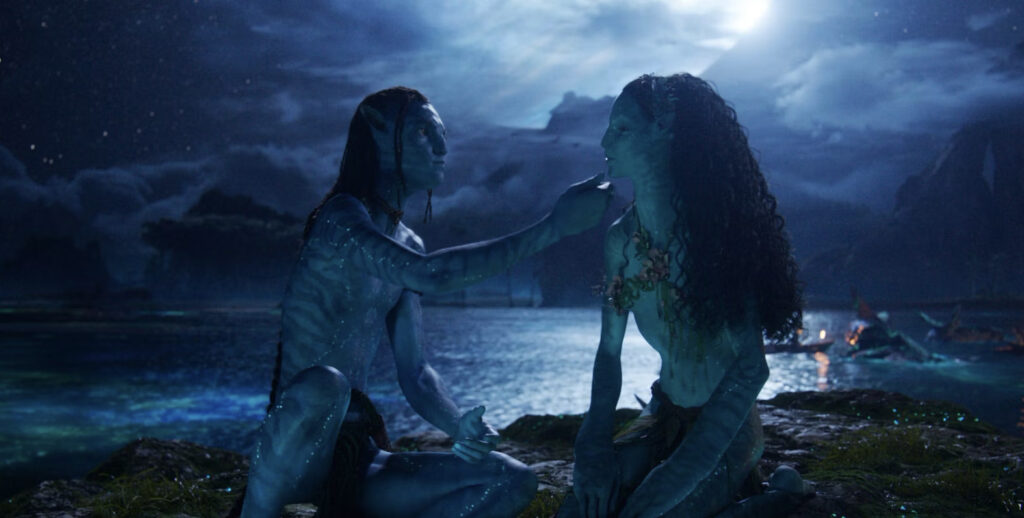
In “Fire and Ash,” those forces don’t just animate fluid and jubilant battles; they course through intensely intimate moments, like when Kiri (Sigourney Weaver) and Tsireya (Bailey Bass) converge around Lo’ak—who, overwhelmed by grief and guilt, has just pressed a machine gun to his jaw.
“Stay in this life, brother,” Kiri begs Lo’ak. “We need you.” In an era where many blockbusters would rather obliterate swaths of humanity than meaningfully consider a character’s mental health, her words are a reminder that as much as James Cameron needs an audience, we need him more.