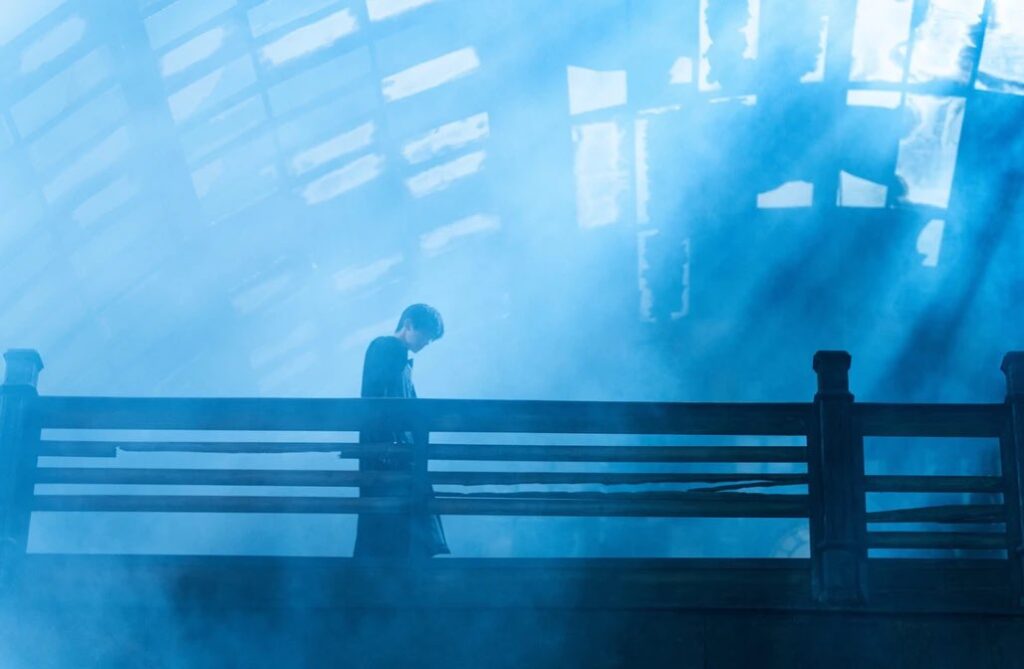
Bi Gan is the kind of filmmaker who can inspire moviegoers to cross state lines. Just ask my friend Geoff, who drove 114 miles to see “Long Day’s Journey Into Night” (2018), Bi’s surrealist voyage into one man’s desires and dreams.
Unfortunately for Geoff, that particular screening was scuttled by a malfunction at the theater. That, in a way, is the beauty of cinema: It is spurred by the pursuit of uncertain, impermanent rewards, often at personal cost (the cost of gas, for one).
In the case of “Resurrection,” Bi’s latest ethereal sojourn, the price is worth paying. As seductive in its sincerity as it is irresistible in its ambition, the film is not only a valentine to moviegoing, but a challenge to moviemakers—to do better, to dream bigger.
Ostensibly, “Resurrection” is set in a “wild and brutal era,” which makes it sound like a “Mad Max” spinoff. Yet rather than reach for the future, Bi pursues a figure known simply as “the Deliriant” (Jackson Yee) across the 20th century and the cinematic genres it birthed.
Among the focal points of Bi’s fascination are silent-era fantasy, matte-finished film noir, con-man capers, and fang flicks (the film’s final act is like Wong Kar-wai’s “Chungking Express” with vampires, which may actually make it an homage to Quentin Lee and Justin Lin’s little-seen “Shopping For Fangs”).
Like “Long Day’s Journey Into Night,” “Resurrection” is at once beautiful and baffling. To get where Bi is taking you, you have to be comfortable with lostness—to make peace with the fact that plot is beside the point in the film’s woozy, allegorical landscape.
In this world, we are told, the Deliriants “bring pain to reality and chaos to history.” That is because they continue to dream, even as most humans sacrifice the soul of their subconscious in their pursuit of eternal life (in that respect, they’re rather like the populace of the Axiom in “WALL-E”: durable and damned).
Throughout “Resurrection,” one of the only things that isn’t a mystery is the symbolism of the Deliriants: They are filmmakers, film fans, and film itself, embodying the power of transient pleasures that are all more meaningful because they are fleeting.
That puts Bi in direct conflict with the pursuit of the infinite that defines the dominant storytelling arenas of our age, streaming and social media. His movies are long—“Resurrection” runs two hours and 40 minutes—but they do end, leaving audiences to stumble back to their everyday lives, struggling to make sense of what they have just seen.
At times, that struggle can be taxing (Bi has yet to master Wong’s seamless fusion of art-cinema imagery with crystalline narrative melodrama). Yet even when “Resurrection” perplexes you, it holds onto you, especially in a poignant closing scene that reflects on its own limited lifespan.
In those final moments, you may sense Bi accepting that across the globe, the visual and emotional grandeur he’s chasing is largely gone. The existence of “Resurrection,” of course, suggests otherwise.