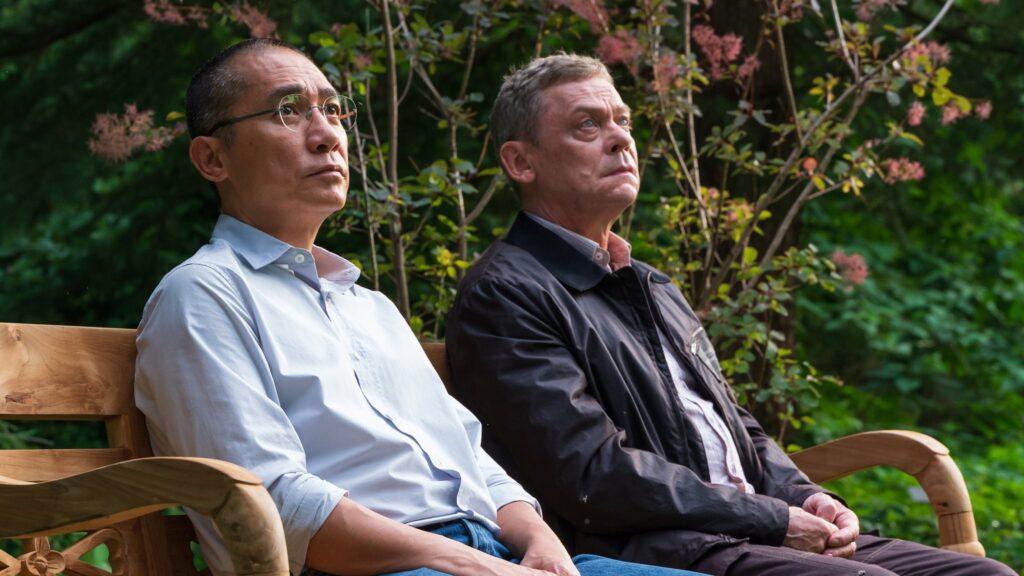
Early in Ildikó Enyedi’s “Silent Friend,” Tony (Tony Leung Chiu-wai) tells a class of enraptured college students that babies are endowed with “lantern-light consciousness”: the gift of perceiving the world as more than a series of isolated images.
“You see, in this softly moving haze, the borders between seen and unseen, observed and unobserved, are fluid,” Tony explains. “It is not about limitation. It is not about separation. It is about being part of some continuous entity.”
Proving his point, Tony tosses a glowing orb to the class, allowing it to bounce from student to student like a miniature sun. He’s illustrating how an infant might perceive the world, but also how an audience might perceive a film that gently gambols across time.
Echoing expansive works ranging from “Intolerance” (1916) to “Resurrection” (2025), “Silent Friend” is such a film—albeit one that extends through eras not in search of grandeur, but of the ecstatic high of one moment (or one life) brushing up against another.
“We could say that babies are high all the time,” Tony tells his students. “Well, this is the state that scientists hope to attain in their rare moments of intuition.” It is also the state that “Silent Friend” attains in scenes that are exquisite, if fleeting.
Like most of the characters in “Silent Friend,” Tony spends his days at a German university increasingly dominated by a ginkgo tree—a gargantuan being that becomes his obsession and salvation when the campus is hollowed out by COVID-19.
“Scientific experiments can be weird sometimes,” Tony tells a groundskeeper (Sylvester Groth) who is unnerved by his single-minded research on the gingko. Therein lies the grace of “Silent Friend”: It evokes the monotony of quarantine, but also the thrill of getting weird to survive.
While will to live reverberates through every story in “Silent Friend,” the stakes vary wildly. When the first woman (Luna Wedler) attends the university in 1908, her life is at risk; when we catch up with a repressed amateur botanist (Enzo Brumm) in 1972, only his virginity is at risk (he hopes).
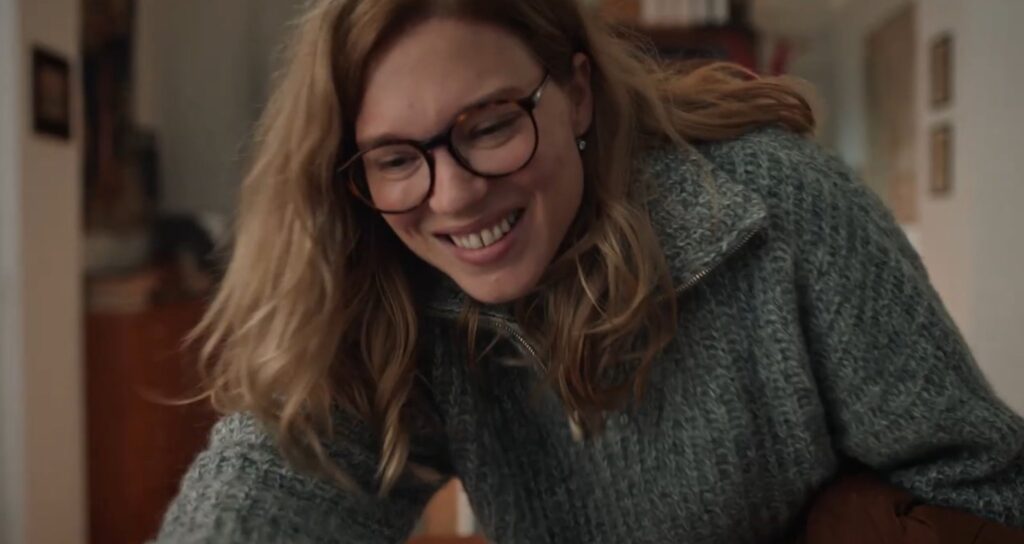
Neither of these intertwined tales blooms as expressively as Tony’s, but his portion of the plot has at least one flaw: the maddeningly brief presence of Léa Seydoux, playing a beguiling French academic who appears solely via video chats.
(Seeing Seydoux’s voluminous charm and charisma—a gently invigorating force in films as different as “Blue Is the Warmest Color,” “Spectre,” and “One Fine Morning”—confined to a computer screen is like seeing the Mona Lisa on Instagram.)
In truth, “Silent Friend” is haunted stories untold, as if Enyedi (the Hungarian director of “The Story of My Wife” and “On Body and Soul”) is still figuring out where her characters are headed or is playing coy in the name of artful (but not always evocative) ambiguity.
“Now we have to wait,” Tony tells the groundskeeper as he nudges the gingko toward the next chapter of its evolution. Unlike a tree, a narrative’s growth is not so easily measured or nurtured, especially when you hold your breath for an epiphany that never arrives.
With a climax as cathartic as Sean Penn roaming the shores of heaven in Terrence Malick’s “The Tree of Life” (2011), “Silent Friend” might have ascended into the pantheon of great films that span over a century (a celestial subgenre still ruled by Malick and Darren Aronofsky, director of 2006’s “The Fountain”).
Of course, to be in same solar system as Malick is an achievement in its own right—and it never hurts to harness the power of Leung, whose presence has been a shorthand for isolation and compassion since he starred in “In the Mood for Love” (2000), Wong Kar-wai’s colossus of repressed yearning.
“Feelings can creep up just like that,” Leung’s character confesses in “Mood.” “I thought I was in control.” Alive with restraint, Leung never loses control in “Silent Friend,” but when the lantern of his consciousness is lit, you never want to be outside of its light.
SEE IT: “Silent Friend” plays at Cinema 21, 616 NW 21st Ave., 503-223-4515, cinema21.com.