“When did you stop being angry?” Ruthye Marye Knoll (Eve Ridley) asks Kara Zor-El (Milly Alcock) late in DC Studios’ “Supergirl.” “Any day now,” Kara answers (after explaining her original trauma to her unlikely young travel companion). If you walked in after the opening credits, you would be able to tell by that exchange alone that the film was directed by Craig Gillespie.
In the last decade, Gillespie has carved a niche directing films with ungovernable leading ladies, with each revisionist narrative being more fantastical than the last. First, he directed Margot Robbie as the controversial Oregon-born figure skater Tonya Harding in “I, Tonya” (2017); next, Emma Stone as an iconic Disney villain with antiheroic punk style in “Cruella” (2021).
Now, DC Studios co-CEO James Gunn has drafted Gillespie (plus writer Ana Nogueira) for a new take on Kara, cousin of Kal-El (that’s Superman to you). As played by Gillespie’s fellow Aussie Milly Alcock (“House of the Dragon”), this Supergirl is distinct from Melissa Benoist’s effervescent performance as the character on TV (not to mention Sasha Calle’s disappointingly brief appearance as Kara in 2023’s “The Flash”).
At the end of Gunn’s “Superman” (2025), Kara was introduced as a pissed-off twentysomething who jaunts to red-sun planets so she can drink her emotional pain away (Earth’s yellow sun imbues Kara with the same powers as Superman’s, including the inability to get plastered).
Picking up where its predecessor left off, “Supergirl” could easily be mistaken for a Gunn-directed film, what with its relentless needle drops (including a beefed-up remix of Blondie’s “Call Me” in the trailer), interstellar action (à la “Guardians of the Galaxy”), and fan-baiting glorified cameos (in this case, erstwhile Aquaman Jason Momoa as the immortal mercenary Lobo).
Momoa wisely manages to avoid figurative chunkiness, being less of a scenery glutton than usual. Wisely, he cedes the spotlight to Alcock and Ridley, whose characters are at the center of “Woman of Tomorrow” (the recent comic series by Tom King and Bilquis Evely that the film adapts).
As in the comics, Ruthye wants to avenge the slaughter of her family by Krem of the Yellow Hills (Matthias Schoenaerts). A strangely handsome evildoer on the page, he’s reimagined by Gillespie as a (mostly) bald marauder with a few hundred too many studs in his face and an arsenal of medieval weaponry (in other words, the sort of supervillain Stephen Miller probably wishes he could grow up to be).
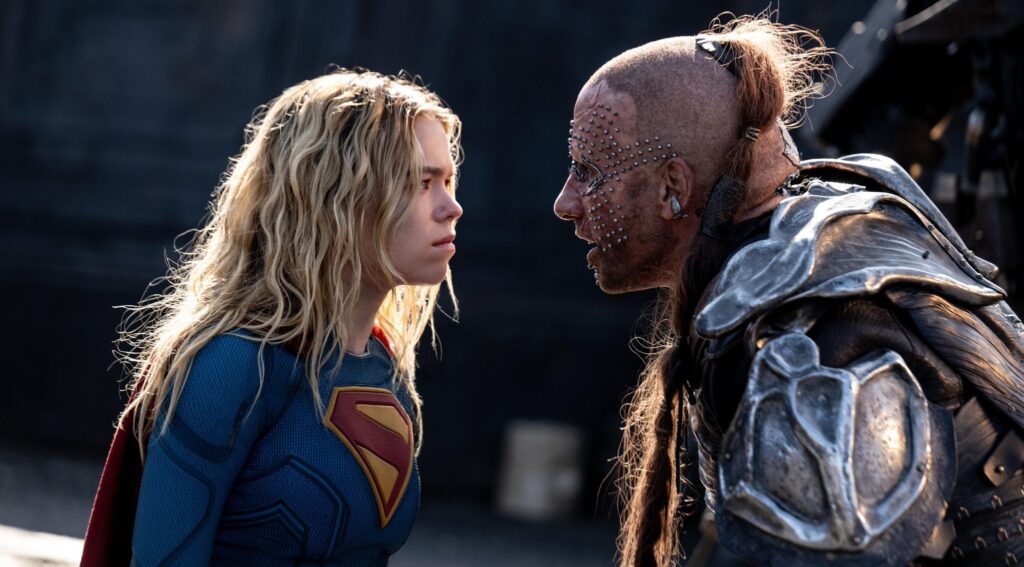
Like Immortan Joe in 2015’s “Mad Max: Fury Road” (directed by Gillespie’s countryman George Miller), Krem is a trafficker of “brides” (to propagate his all-male species); even more reprehensibly, he abducts adult women and teenage girls, while committing acts of cruelty with a vampiric smile (perhaps Robert Eggers should’ve perhaps cast Schoenaerts instead of Bill Skarsgård in 2024’s “Nosferatu”).
Given the allegorical feminist heft of “Supergirl,” it might never have been made under the control of the Donald Trump-aligned Ellison family, which is on the cusp of acquiring DC’s parent company, Warner Bros. This is, after all, the family dynasty that seemingly installed Bari Weiss at CBS News to coddle the Trump administration.
(Also, it’s hard to imagine the Ellisons signing off on the similarities between Krem and Jeffrey Epstein, the infamous sex trafficker who once referred to himself as “Don’s best friend.”)
For now, Paramount Skydance CEO David Ellison appears interested in letting Gunn cook, but he’s no friend to storied franchises, having overseen several “Star Trek” cancellations. Only time will tell how much Gunn will stand up to Ellison and whether filmmakers will be afforded creative latitude within the DC sandbox. (While they ultimately clashed, Gunn initially told Gillespie, “This is your graphic novel.”)
While “Supergirl” was meant to function as a relative standalone, there is plenty of detail to unpack over its 108 minutes—much of which, unfortunately, manifests messily, especially in the film’s early action scenes. For instance, Kara and Ruthye meet an all-female band of teleporting “tech pirate” Sklarian Raiders who hijack their interplanetary bus, but the ensuing set piece is over so quickly that it feels like an irrelevant detour.
(The first act is also unexpectedly lousy with potty humor, from Krypto the Superdog peeing on a newspaper bearing Superman’s face to a foul rest stop snack produced from a giant bug’s droppings. It’s hard not to suspect the influence of Seth Rogen, who has a voice cameo as a lemur-like translator.)
That said, a little mess is to be expected, since “Supergirl” is about Kara’s quarter-life crisis of depression and drinking (in stark contrast to her staid Kryptonian cousin and his belief in kindness as “the real punk rock”). And happily, Alcock truly makes Supergirl her own, developing a believably flawed heroine ready to return afresh next year in Gunn’s “Man of Tomorrow.”
Given her propensity for plugging her own tunes into alien jukeboxes, Kara can always borrow my aux cord. Of course, that’s on the condition that she take a listen to the words of my fellow Maltese, Sharleen Spiteri of the Scottish band Texas, in a song I may or may not have sung on karaoke night at a Beaverton bar: “I don’t want a lover…I just need a friend.…”