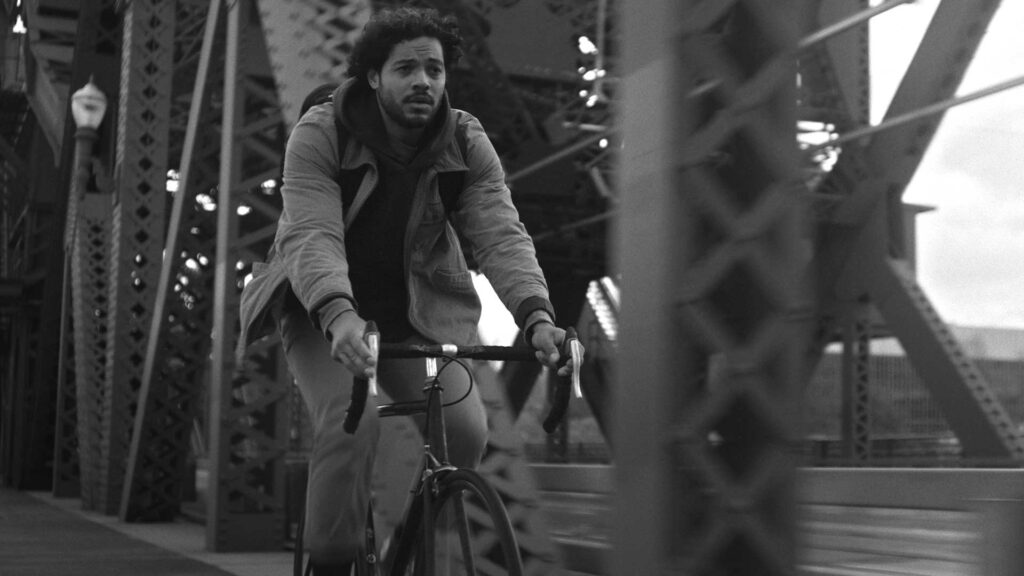
There is a moment in Mark Alan Hoffman’s “A Simple Machine” when a veteran cyclist shames a callow newbie with a righteous battle cry: “Get a fucking helmet, asshole!” Consider it a clue that the film was made not only for people who like movies, but for people who like bikes.
Based on Evan P. Scheider’s novel “A Simple Machine, Like the Lever,” Hoffman’s film moseys along in the shadow of Nick (Richard Blackmon), a troubled loner who literally believes life should be as simple as riding a bike—and must grapple with the nobility and the naïveté of that conviction.
“Some things you do have to pay for,” Nick muses soberly. That said, his goal is to pay as little as possible—for food, for housing, and for the Thoreau-esque eccentricities that steadily alienate him from his almost-too-good-to-be-true girlfriend, Marie (Gabriela Quezada).
A pandemic-era fable set in Portland, Oregon (and shot in nicely textured black-and-white), “A Simple Machine” is filled with images that will resurface your repressed memories of 2020. Faces are covered by masks; protests are playing out on television screens; and when Nick’s mother passes away, he mourns from afar, bowing to the contours of COVID-19.
Perhaps spooked by his mother’s hoarding (her home is clogged with cigarettes and VHS tapes), Nick becomes increasingly monkish. He bunks on a mattress in a garage. He sells his car, his cellphone, and his furniture. He refashions a battered bike as a one-speed, dreaming of riding up the notoriously steep North Mississippi hill.
From the moment Nick’s mother passes, it’s clear that he’s chipping away at his life to guard against grief—which doesn’t invalidate his perspective. After all, he explains to Marie after he announces he’s swapped his cell for a landline, humans survived for a long time without cellphones. It’s not like he’s relying on a tin can and twine.
That, of course, isn’t much comfort to Marie, who is portrayed as a disturbed bystander in Nick’s quest for simplification. At a screening I attended earlier this year, moderator Marc Mohan joked that perhaps Marie should have joined Nick in going full Thoreau, an offhand quip that suggested an intriguing road not taken.
While I would have liked “A Simple Machine” to complicate the roles Nick and Marie fall into (wayward man, skeptical woman), I admire Hoffman’s refusal to reduce Nick to a patron saint of simplification. There are limits to a purist philosophy, Nick learns, and symbolic significance to the material possessions he forsakes. (A car is not just a car: It’s a means to drive a loved one to the coast.)
As “A Simple Machine” closes, you sense that Nick has at least slightly moderated his beliefs. That could be interpreted as selling out, but it’s also a sign that he’s growing up—just like his decision to finally get a fucking helmet.
SEE IT: A Simple Machine plays (with director Mark Alan Hoffman and author Evan P. Schneider in attendance) at Cinema 21, 616 NW 21st Ave., 503-223-4515, cinema21.com. 7:00 pm Sunday, September 20. $9-$11.