
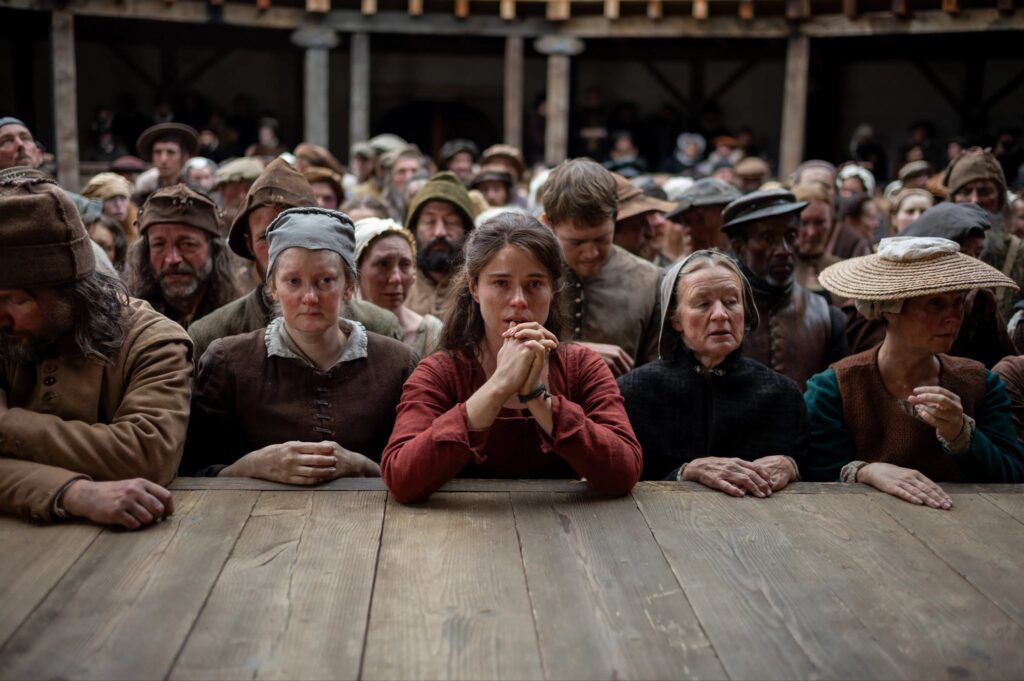
Shortly after William Shakespeare (Paul Mescal) first meets Agnes (Jessie Buckley), she asks him to tell her a story. It’s the only thing to be done, really. Reduced to a bumbling romantic by Agnes’ harsh charm and earthy beauty, Will seems incapable of speaking words that are his own.
So he tells her the story of Orpheus: his passion for Eurydice, his descent into the underworld (to quote Ovid’s Metamorphoses, “At length I yielded, won by mighty love”). It’s English department flirtation as its finest, and a reminder of storytelling’s power to express the seemingly inexpressible.
That power propels Chloé Zhao’s “Hamnet” from the verdant intimacy of Stratford-upon-Avon to the chaotic grandeur of the Globe Theatre—a voyage that reveals the film to be not only a tormented romance between a woman and a man, but between wildness and civilization.
“He loves me for what I am, not what I ought to be,” Agnes says of Will. And what is Agnes if not a creature of the forest, first seen as the camera tilts into a tangle of roots where she is hunkered, like a child in the womb? (The cinematography is by Łukasz Żal, an Oscar nominee for “Ida” and “Cold War.”)
Most of the characters in Zhao’s films are of the earth: Brady Jandreau’s rodeo cowboy in “The Rider” (2017), Frances McDormand’s enigmatic drifter in “Nomadland” (2020), and even the conflicted superbeings who defy their cosmic overlord by defending humanity in “Eternals” (2021).
“I have seen them create and dream,” Ajak (Salma Hayek) says in “Eternals.” “This planet and these people have changed me.” In “Hamnet,” Agnes, too, is changed, drawn from her woodsy cocoon and into a world where creation and dreaming are the only salvation from loss.
Based on a 2020 novel by Maggie O’Farrell (who wrote the film’s screenplay with Zhao), “Hamnet” is a mossy vision quest—an imagining of how the death of Shakespeare’s son Hamnet (played in the film by Jacobi Jupe) could have inspired a play about a Danish prince whose name differs by a single letter.
“Hamnet and Hamlet are in fact the same name, entirely interchangeable in Stratford records in the late 16th and early 17th centuries,” Stephen Greenblatt wrote in The New York Review of Books in 2004. That quote appears onscreen at the start of “Hamnet,” hastily alluding to fact before the film plunges into feeling.
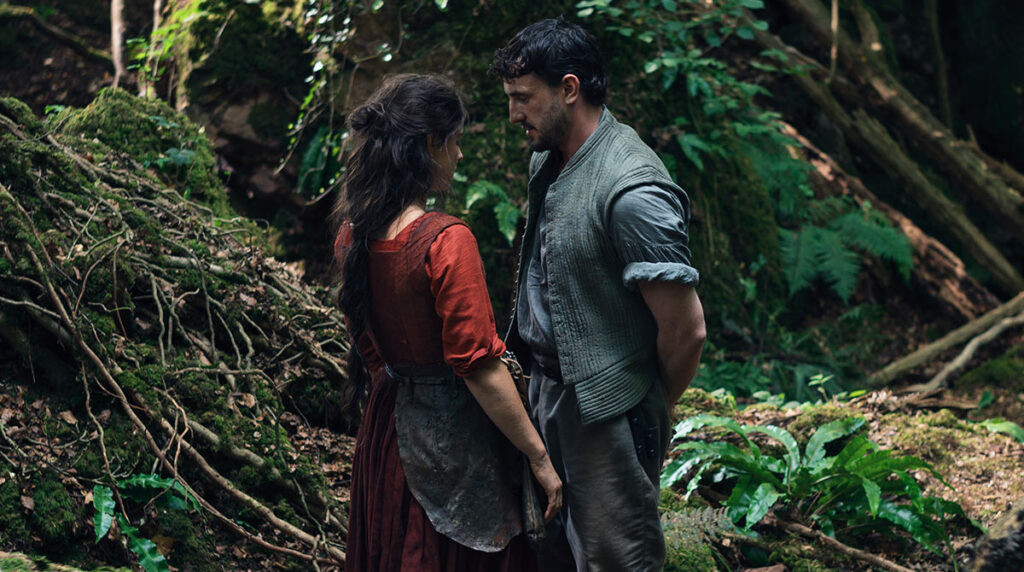
If the end of “Hamnet” is illuminated by anguish, the beginning is borne aloft by lust. Emerging from the forest with a hawk perched on her gloved hand, Agnes first glimpses Will wearing a shade of blue that pales before her alluring blood-red gown (a garment with as much allegorical heft as the faded pink dress Buckley wore in Alex Garland’s “Men”).
Mixing Mescal’s squirrely neediness with Buckley’s lion-like poise, Zhao brews a sexual potion of delicious combustion. There is no kneeling when this Bard proposes; he warily circles Agnes, nervously tapping her on the shoulder as if fearing where further touch might lead.
“You’re a good man,” Agnes later tells Will. Yet the two are drawn together not by goodness, but by desires that are consummated during a ferocious tryst in a barn. (When confronted about whether or not he fathered the now-pregnant Agnes’ child, Will, barely able to believe it, gleefully announces, “I did!”)
As a portrait of intermittent familial bliss, “Hamnet” isn’t entirely convincing (I might be jealous that my own boyhood swordplay wasn’t quite as adorable as Hamnet’s). Where Zhao—and her lead actors—thrive is in the realms that precede and follow children: sex, birth, and grief.
“The women in my family see things,” Agnes declares. Said to be the daughter of a “forest witch,” she prefers to go into labor alone and among trees, a ritual precluded by a rainstorm on the day that Hamnet is born (an image of water surging beneath a door beautifully prophesizes the incipient tides of despair).
While there’s an intriguing mysticism to the idea of Hamnet being marked for death by the separation from his mother’s natural habitat, his end is at once cataclysmic and ordinary. In 16th-century England, roughly a third of all children died before turning 10, a chillingly common tragedy alluded to by Will’s mother, Mary (Emily Watson).
“Never forget for a moment, they may be gone,” she warns. It is the universality of that statement that makes “Hamnet” more than a movie about one playwright, one family, or one kind of heartbreak. It is a film for anyone who has known loss—and sought catharsis through storytelling.
“To be, or not to be, that is the question,” Will chokes out, staring into a watery abyss as moonlight peeks through ink-gray clouds. Has he already written those words? Or has hopelessness forced them out of him at that very moment? Zhao chooses to sustain the mystery, deepening the dialogue’s effect (on Will and on us).
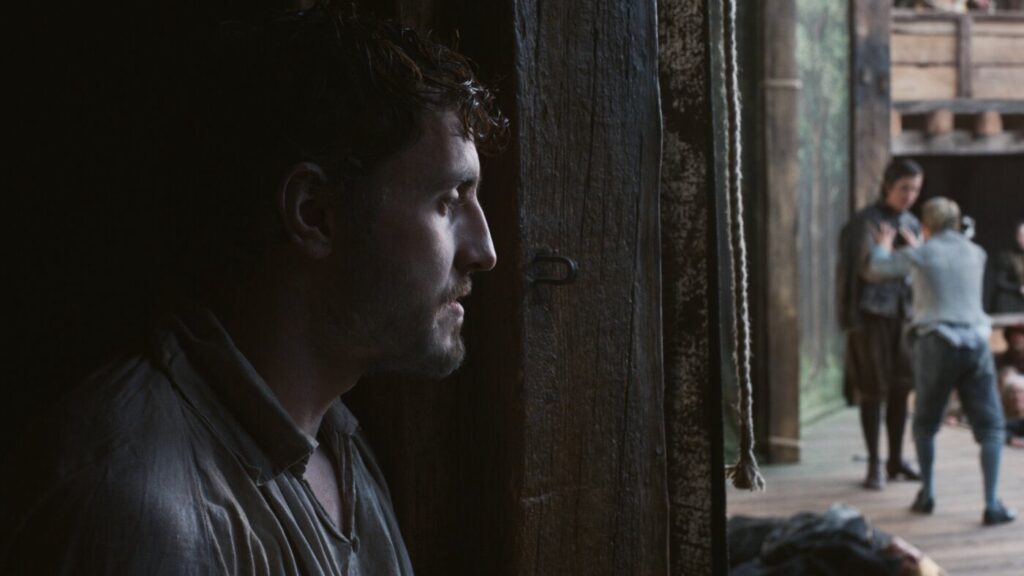
Though Will blossoms into a piercingly stricken co-protagonist, we are aware of but rarely witness to his theatrical career in “Hamnet.” That is why to watch Agnes watch “Hamlet” is to see the play as if for the first time, stirred not by its cleverness, but by its humanity.
“We have a collective mother wound, just because the feminine consciousness has been repressed for thousands of years,” Zhao recently told Puck News. “Hamnet” may be blessedly in nature’s thrall, but it is equally entranced by costumes, performances, and words that bandage the wounds of mothers, fathers, and siblings left behind.
That includes Hamnet’s sisters, Judith (Olivia Lynes) and Susanna (Bodhi Rae Breathnach)—and, in a less-than-literal sense, the nameless actor playing Hamlet (Noah Jupe, brother of Jacobi Jupe), who bursts to life as he excitedly recites, “To sleep, perchance to dream!”
Those words do not mean less to Agnes because the performer is a poor facsimile of her child; they mean more because he is a stranger, speaking to her as a living dream of the man Hamnet never grew to be (as Hamlet pointedly says in the play, “And in this harsh world draw thy breath in pain/To tell my story”).
For all its grimy intensity, “Hamnet” is about the communal ecstasy of absorbing a story with a crowd of strangers. The audience at the Globe may not recognize the play’s genesis (or Shakespeare’s spouse in their midst), but the fact that they are moved by “Hamlet” tethers them to Will and Agnes, pulling back the shadowy veil of their shared pain.
If the climax of “Hamnet” amounted to anything less than wrenching transcendence, Agnes would be diminished by her role as spectator. That she is not is a testament to Zhao’s rapturous depiction of spectatorship—of haunted playgoers reaching toward the stage, their hands like planets orbiting a luminous star.
I suspect that sort of directorial feat is what inspired filmmaker Barry Jenkins (“Moonlight”) to sing Zhao’s praises in jubilantly profane terms during a recent Directors Guild of America interview. “You are Chloé mother-fucking Zhao!” he told her. “You got statues, girl.” (In 2021, Zhao became the second woman to win the Best Director Oscar, for “Nomadland.”)
It wouldn’t surprise me if Zhao won a few more statues—though in my mind, her latest odyssey of the heart has already triumphed. Because what “Hamlet” does for the audience in the film, “Hamnet” did for me.


One Response