The Christophers
As a grandiloquent artist in Steven Soderbergh’s “The Christophers,” Sir Ian McKellen will likely delight everyone—with the exception of Brian Cox, his fellow “X-Men” villain (and his severest critic).
“I want to make it absolutely clear that I do not in any way, shape or form dislike Ian McKellen,” Cox writes in his 2021 memoir “Putting the Rabbit in the Hat.” He then details all the ways, shapes, and forms in which he dislikes McKellen, dismissing his work as “front-foot” acting and “a schtick.”
I doubt “The Christophers” will dispel the notion that McKellen is a self-amused showman—nor should it. Whether he’s chortling, growling, or romping, to watch him act is to inhale the vapors of the contagious joy he takes in his craft. Thespian contact high!
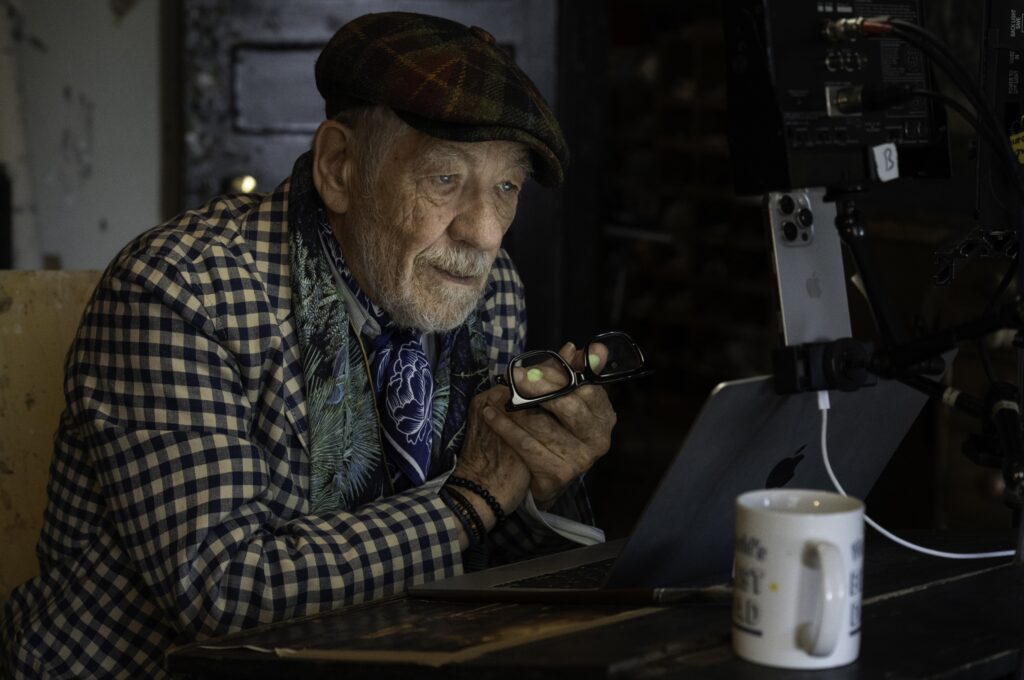
In “The Christophers,” McKellen floats even higher than usual as Julian Sklar, a “justifiably canceled” painter reduced to selling his canvases on the sidewalk. He’s a man living lightyears from the zeitgeist, yet curiously at ease in exile, recording irascible messages to his fans and bickering with his assistant, Lori Butler (Michaela Coel).
Soulful and shrewd, Coel both boxes McKellen in and keeps him on his toes. Lori may be armed with an agenda, but Coel and McKellen nurture their characters’ tangle of egos until it blossoms into something subtler: a tango on the thin line between artist and imitator, between forgery and truth.
“It’s not uninteresting,” Lori observes after Julian desecrates one of his paintings with a smattering of feathers and glitter. Even when he’s making a mockery of his own genius, he’s still a genius, front foot and all. R. Opens Thursday, April 16, at Cinema 21, Living Room.
“Hamlet”
Alas, poor Horatio, I knew him—but I won’t protest him being combined with Ophelia in Aneil Karia’s “Hamlet,” which transplants the tragedy of Denmark’s mercurial prince to the bloody landscape of London real estate.
“There are more things in heaven and earth, Ophelia/Than are dreamt of in your philosophy,” Hamlet (Riz Ahmed) tells Ophelia (Morfydd Clark). As with most of the tweaks in this propulsive adaptation, there’s sly method to what some Shakespeare scholars might dismiss as revisionist madness.
Stripped of minor players (2026 just isn’t your year, Osric fans) and condensed to 114 minutes, Karia’s film is quick and grim. Ahmed’s Hamlet is no Branagh-esque prankster; he fights hard and he drives angry, bellowing “To be or not to be” behind the wheel of a careening BMW.
If the amplification of brutal vengeance over courtly masquerades risks exhausting the audience, it is a risk gracefully mitigated by peerless players—including Clark (an Ophelia more confidant than casualty) and Sheeba Chaddha (a Gertrude more nihilistic than hapless).
“Don’t drink, Gertrude,” warns Claudius (Art Malik) as his bride goes for the lethal brew meant for Hamlet. Too late. This time, Gertrude doesn’t obliviously sip; she gulps half a bottle, reminding us that Shakespeare always has more secrets left to spill. R. Now playing at Fox Tower, Living Room.
Exit 8
The first time I was in Toronto, I found myself staggering through an underground food court, hoping to scarf a Pumpernickel’s sandwich before a movie. It was a simple plan impeded by an embarrassing problem: In a weary daze, I walked straight past Pumpernickel’s. Multiple times.
In the aftermath, I rationalized my disorientation (I’m not dumb! I’m jetlagged!). Yet lostness can’t help but breed fear and shame, especially in a confined space where you’re certain that you should be able to figure this out.
That conviction surges through Genki Kawamura’s “Exit 8,” a repetitive but intelligent thriller about a Lost Man (Kazunari Ninomiya) locked in a subway corridor that becomes a closed loop. On the same day, as fate would have it, that his partner (Nana Komatsu) announces she’s pregnant.
While “Exit 8” is based on a video game, Kawamura isn’t playing games; he’s using game mechanics to capture the terror and the thrill of standing on the precipice of irrevocable change (rest assured, this is much more than “Commuter’s Creed: Commitment Phobia”).
“Not this way,” the Lost Man says to himself, not yet comprehending that he is both physically and emotionally trapped. He’s looking for an exit, but this is no maze—and the path forward will only appear when he’s ready to see it. PG-13. Now playing at Fox Tower, Living Room, Lloyd Center.
The Drama
In 2011, A.O. Scott said that it is “in the nature of film audiences—consciously or not, admittedly or not—to find pleasure in what they see.” If that’s true, a disturbing number of filmmakers—Gus Van Sant, Denis Villeneuve, Brady Corbet, and now Kristoffer Borgli—want moviegoers to find pleasure in the subject of school shootings.
To be fair, Borgli’s “The Drama” is about a massacre that almost happened, as Emma (Zendaya) tells her fiancée, Charlie (Robert Pattinson). Bullied and isolated as a teen, Emma planned to kill her schoolmates with her father’s rifle, but found friendship and acceptance among gun-control activists (I believe this is what screenwriting manuals refer to as “irony”).
If “The Drama” were about a different issue, I might have been able to buy it as a universal myth about the romance of sharing your ugliest impulses with your beloved (squirmy and weepy, Pattinson embodies a less frightening form of ugliness). The problem is that school shootings aren’t universal: They’re the work of feckless nations that allow sick individuals to possess weapons of war.
“Art has the capacity to deepen public understanding and create emotional clarity and awareness, but it can also flatten and distort reality,” Jackie Corin, a survivor of the Parkland shooting and a co-founder of March For Our Lives, recently said. By that logic, a flattening movie like “The Drama” isn’t just a provocation. It’s a pancake. R. Now playing at Cinema 21, Fox Tower, Laurelhurst, Lloyd Center.