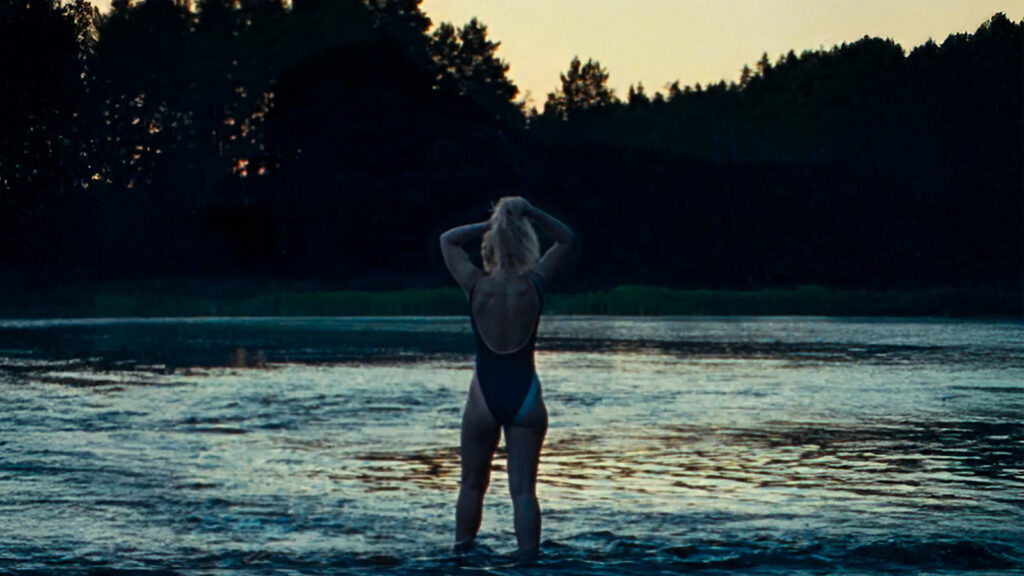
In 1963, John F. Kennedy was assassinated, Martin Luther King Jr. marched on Washington, Valentina Tereshkova became the first woman in space, and Lidia Yuknavitch was born in San Francisco.
“By the time I arrived in the family, eight years after my sister, the laws of the house were in place. But none of them seemed to work on me,” Yuknavitch, an Oregon Book Award winner and Ken Kesey protégé, writes in her 2011 memoir “The Chronology of Water.” “By the time I was four, when I cried, I wailed. Epically.”
After being immersed in Kristen Stewart’s cinematic recreation of “The Chronology of Water,” I wanted to wail, too. How could I not? With each surge of knife-like visual fragments—a hand striking a girl’s backside, a head lying next to a passing train, a page rippling underwater—the film leaves you overpowered, gasping for breath.
“No one’s big enough to hold what happens to us,” Kesey (Jim Belushi) tells Lidia (Imogen Poots). No movie could be big enough to hold what happened to Yuknavitch either, but Stewart comes as close as any filmmaker could, distilling her subject’s life one texture at a time: water, blood, flesh, fury.
“You will see you have an underlying tone and plot underneath the one you’ve been told,” writes Yuknavitch. “Circular and image bound.” That is what Stewart hungrily pursues: the tone and plot that circle rather than progress, evoke rather than explain.
Little is explained in the early scenes of Stewart’s film; little needs to be. You may not clearly see Lidia being sexually abused by her father, Mike (Michael Epp), but Olivia Neergaard-Holm’s brutally sharp editing makes you feel his oppressive presence—alongside Lidia’s helplessness and rage.
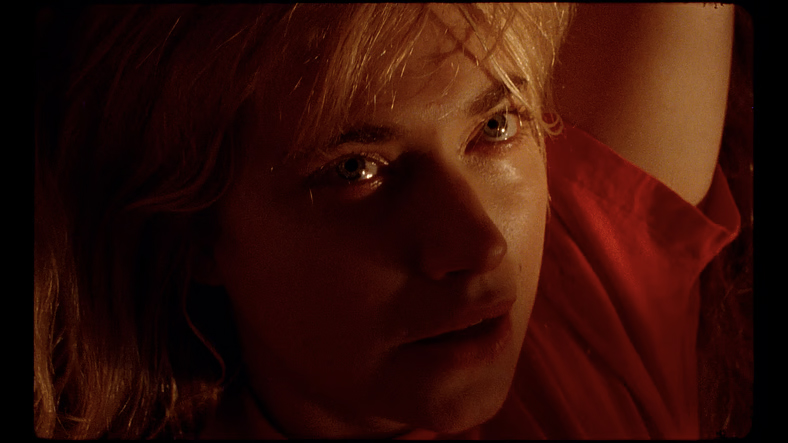
“I wrote about my father’s loud angry voice,” Yuknavitch remembers in “Chronology.” “How I hated it. How I wished I could kill it.” In the book and the film, she chases careers in competitive swimming and soul-excavating writing—from Florida to Texas to Oregon—while facing further torment, including the birth of a child who is dead before she leaves the womb.
“Death is a motherfucker,” Kesey tells her, casually passing her a flask during a novel-writing course at the University of Oregon. In a lesser film, Lidia’s anguish might have been easily alleviated by the Merry Prankster-in-Chief, but when she later speaks in a dried-out monotone at a prestigious poetry reading, you know it was never that easy.
After her daughter’s death, Yuknavitch wrote stories about women “scratching and screaming and trying to get out and trying to survive,” words that Poots appears to have absorbed into her bones. As Lidia, she can be unnervingly still, but also frighteningly kinetic—the opposite, in other words, of the serene actress she played in Terrence Malick’s stylistically similar “Knight of Cups” (2015).
“We’re not leading the lives we are meant for,” Poots counsels a spiritually adrift screenwriter (Christian Bale) in “Cups.” “We’re meant for something else.” For Poots, that “something else” is “Chronology,” which frees her to exude the kind of operatic, existential anguish that movies too often assign solely to male behemoths like Bale.
(Incidentally, Poots is not only an entrancing performer; she’s also a provocative cartoonist whose frank, mischievous imagery is spiked with Yuknavitchian punkishness.)
In “Chronology,” the ascendent femininity of Lidia clashes with the tender masculinity of her first husband, Phillip (Earl Cave, son of Nick). It’s a marriage marked for death by the unbridgeable gulf between two radiant images: Lidia’s face bursting suddenly out of a swimming pool and Phillip standing calmly beneath a wooden archway, guitar in hand.
“The most passive man on the fucking planet,” Lidia seethes. It turns out that her father’s violence isn’t just a bomb; it’s a blast radius that makes Lidia wary of Phillip’s gentleness (so wary that she punches him in the nose and calls him a pussy).
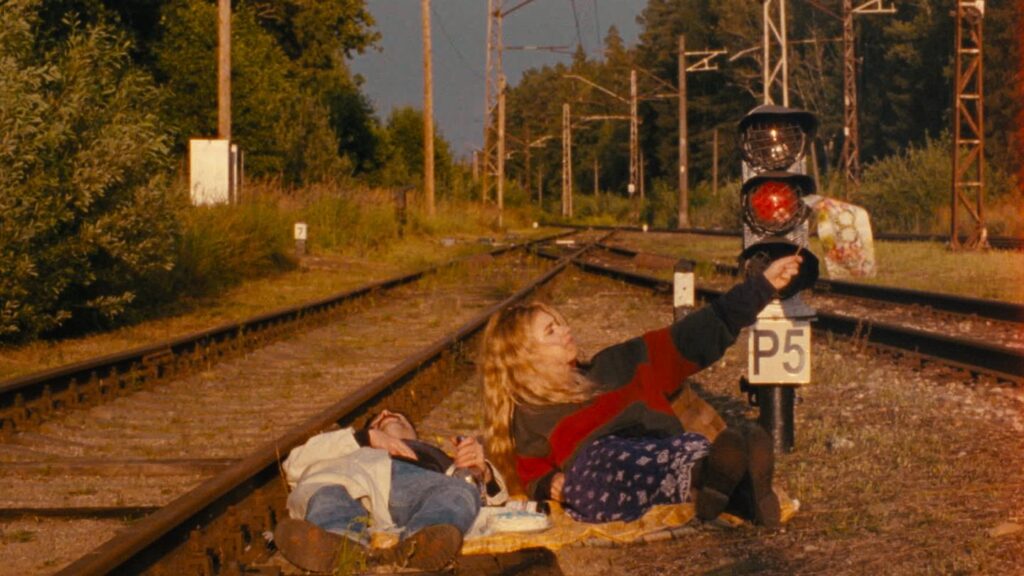
Throughout the film, Lidia yearns for both men and women—true not only to Yuknavitch, but also, perhaps, to Stewart, who cheekily came out to Donald Trump on Saturday Night Live (“I’m, like, so gay, dude”) and forbearingly explained bisexuality to readers of The Guardian (“It’s not confusing at all. For me, it’s quite the opposite”).
There’s a mirrored complexity in the kinship between Yuknavitch (swimmer, teacher, writer) and Stewart (actor, celebrity, filmmaker). In fact, as Stewart told The New York Times in 2022, Yuknavitch “helped shape my relationship with expression itself. Not a small thing.”
I don’t doubt that’s true, but Stewart is more than a mere Yuknavitch acolyte. While the latter confronts readers with scarily direct prose, Stewart is an elusive storyteller, allowing characters to fluidly appear and depart without explanation—and rarely permitting a conversation to play out from start to finish.
(When I think back on the film, I don’t remember exchanges. I remember sentences: “He was a boy,” “I almost loved her,” “I hope something karmically fucked happened to him.”)
Therein lies the paradox of “Chronology”: The stingier Stewart is with the details, the more deeply we care (more shades of Malick). We may not always know the when or where of a scene, yet we leap into the maelstrom that is Lidia’s existence, trusting that we will sense what we cannot understand.
It’s thrilling to lose yourself in a movie as it leads you, even (especially!) when you’re unsure where it’s heading. That said, I’m guessing the cosmic destination of “The Chronology of Water” lies somewhere between 1963 and 1990—the year that earthquakes convulsed Iran and the Philippines, the Human Genome Project began, the Hubble Space Telescope was launched, and Kristen Stewart was born.
SEE IT: The Chronology of Water plays (with Lidia Yuknavitch in attendance) at the Tomorrow Theater, 3530 SE Division St., 503-221-1156, tomorrowtheater.org. 3:00 pm Sunday, April 26. $15.