Though only one of them sits in the director’s chair this round, two of the men behind “The End of Oak Street” have been in director’s jail since before the pandemic. The first artistic felon: David Robert Mitchell, who crafted the intensely creepy STD allegory “It Follows” (2014), but nearly drowned in middling reviews with his follow-up, “Under the Silver Lake” (2018).
While Mitchell is now preparing his long-awaited horror sequel “They Follow,” it’s taken the family friendly, PG-13-rated “Oak Street” to break him out of the Hollywood slammer—with a little help from producer J.J. Abrams, who’s currently in postproduction on next year’s “The Great Beyond” (his hoped-for redemption following the galactically disappointing “Star Wars: The Rise of Skywalker”).
Though Mitchell built the bones of “Oak Street” as writer and director, Abrams is inescapable. As a producer, he brings the Spielbergian family drama of “Super 8” (2011) to “Oak Street,” beginning with the expected Michael Giacchino score (Giacchino’s music is the soul and spine of all the non-“Star Wars” Abrams adventures).
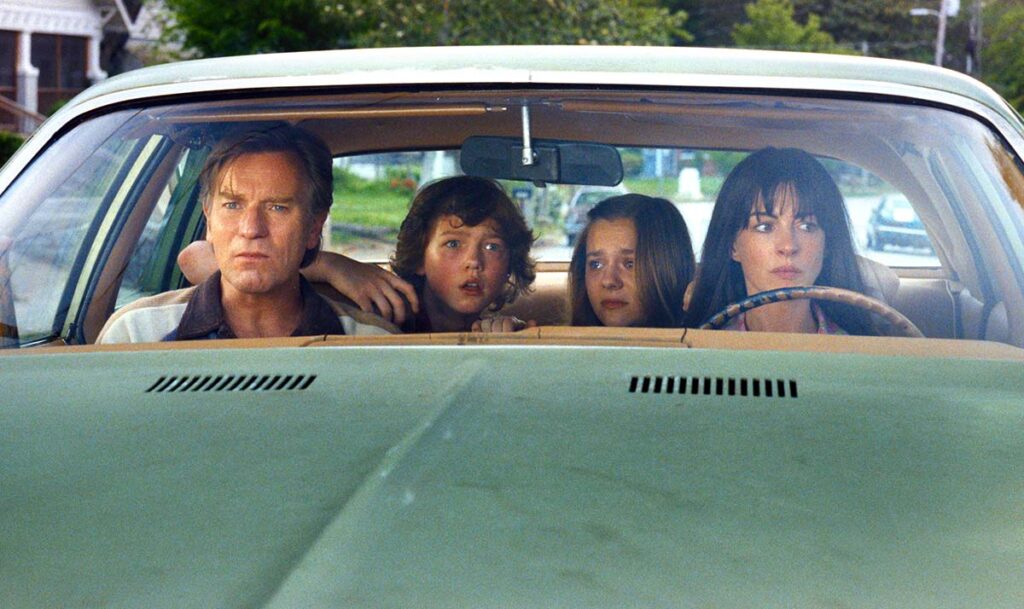
Like “Super 8,” “Oak Street” is a throwback to peak Spielberg set in the suburban Midwest (Atlanta doubles for Mitchell’s native Michigan, circa the early ’80s). If there’s a block party, you can bet on hearing Pat Benatar and The Cars—and running into a couple, like Greg and Denise Platt (Ewan McGregor and Anne Hathaway), on the verge of divorce. (Here, Hathaway is just as strong a matriarch as she was in “The Odyssey.”)
The Platts are practically a walking nostalgia mood board. Greg drives a dark-red Dodge Omni to deliver pizzas (an homage to the Little Nero’s delivery car in “Home Alone”); Denise spends her nights concocting a novel on her typewriter; and a friendly librarian named Mrs. Valcourt (Emily Kuroda) provides research assistance in lieu of the internet.
At the library, Denise asks about a strange plant that has somehow sprouted in her friend’s backyard, which Mrs. Valcourt immediately identifies as prehistoric flora. That (plus “one big pile of shit” to rival the triceratops droppings from “Jurassic Park”) marks the first clue that dinosaurian shenanigans are afoot.
When a roaring light rages through the night sky and suddenly transports the whole neighborhood to the land of the dinos, the Platts put aside their marital issues to protect their kids from an inescapable, blazing hot jungle. And, being a survival thriller, the movie uncages some of the ugliest, nastiest dinosaurs put to screen.
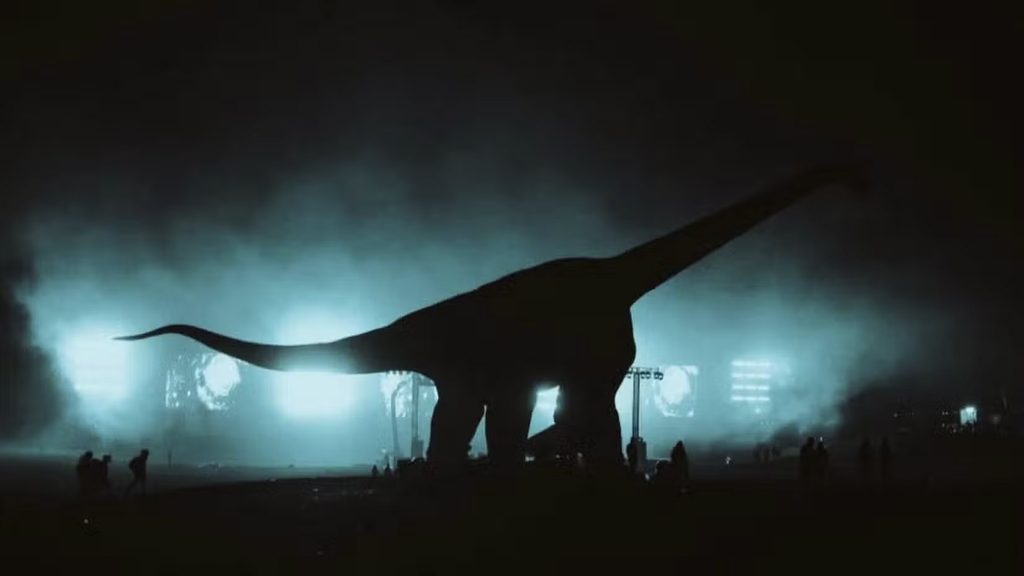
The usual suspects are here: rampaging allosaurs, spoonbilled pterodactyls, raptors with black feathers and oversized beaks. But what takes the cake is the Titanoboa, a white serpent too big to show in its entirety, with vacant eyes that seem adorable…until it opens its mouth, revealing more teeth than there are taquerias in Texas.
While “Oak Street” admirably aims for naturalism (in contrast with the “Jurassic” films’ designer dinos), some slice-of-natural-life moments veer into unintentional cringe. Case in point: The whole movie stops for Denise to take a Polaroid picture of Greg in front of two dinosaurs mating against a garage (their feathers so shaggy it looks like King Kong finally found a girlfriend his size).
As neighbors are killed in dinosaur attacks, Mitchell steadily raises the stakes (there’s also a slowly spreading fire that will stoke fear in Pacific Northwest residents, not least of all those living in Spokane or the Okanagan). Yet when the youngest Platt, Brian (Christian Convery), is onscreen, Mitchell invokes adolescent clichés that ought to be extinct (Greg actually calls Brian out for secretly smoking).
To make matters worse, Brian is so devoted to his dear dog Starbuck that when he vanishes, Brian sneaks out in the night to find him, forcing his sister, Audrey (Maisy Stella), to follow. At least Audrey is more compelling than Brian, with Mitchell focusing on her interest in science.
(Audrey is the first in the family to grasp that the lights in the night are wormholes—and there’s also a subtle implication that she’s starting to figure out that she’s attracted to girls, allowing Stella to infuse the character with a key aspect of her own identity.)
Ultimately, all the buildup fizzles with a rushed and painfully cheesy conclusion, which feels less like Mitchell’s work and more like that of a focus group. It’s hard not to wonder if Mitchell’s initial vision was more in line with his bleaker films, as well as other Abrams productions (“Cloverfield,” anyone?).
With Mitchell now at work on “They Follow,” I imagine he’s grateful to have broken out of director’s jail and be working on the project he really wants to sink his teeth into. That said, no matter how many entities he populates his next film with, it’s safe to say that none will be as terrifying as that Titanoboa.