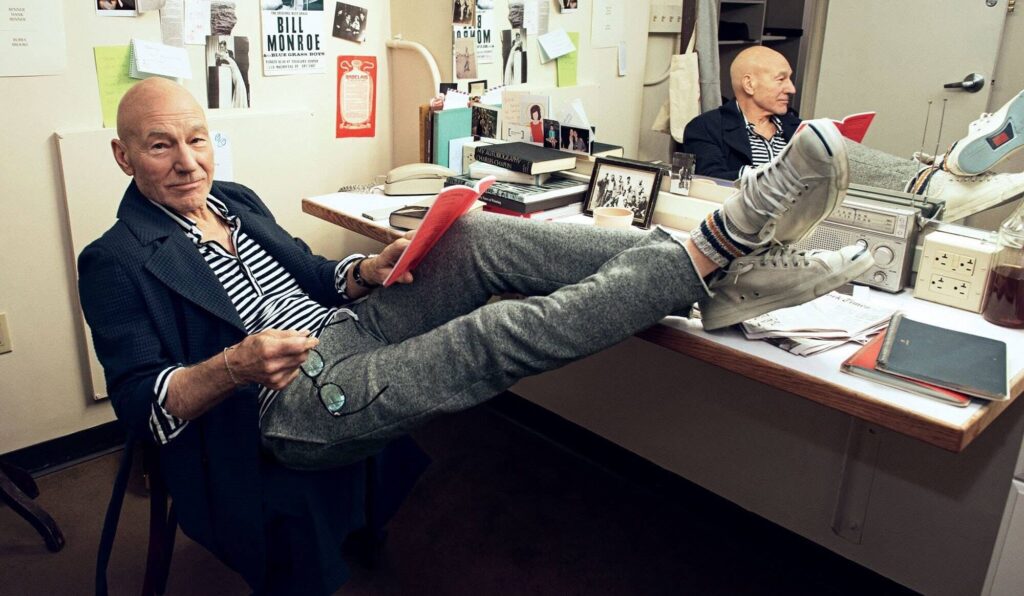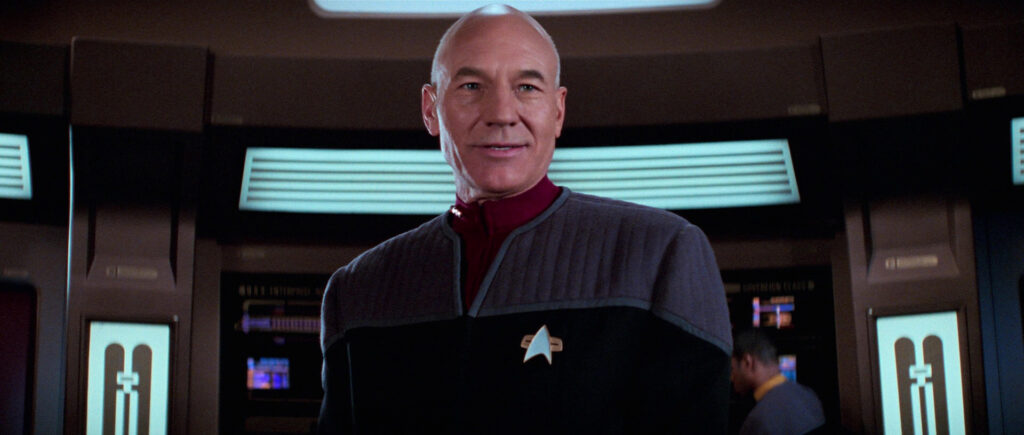
In the sixth season of “Star Trek: The Next Generation,” Captain Jean-Luc Picard (Sir Patrick Stewart) tells a sorrowful and wondrous tale: how he experienced a life’s worth of memories from the long-dead planet of Kataan, thanks to the spiritual machinations of a spindly alien probe.
“Why are you telling me this?” asks Lieutenant Commander Nella Daren (Wendy Hughes), the piano-playing science officer the captain has fallen in love with. “Because I want you to understand what my music means to me,” says Picard, who plays a flute from Kataan in his duets with Daren. “And what it means for me to be able to share it with someone.”
For Stewart—who died at 86 of Alzheimer’s disease and Lewy body dementia on October 28—sharing his acting meant at least as much. Born in 1940 in Mirfield, England, he was delayed in arriving because his mother (“a kindly soul who loved the movies”) refused to send a neighbor to interrupt the midwife (who was attending a matinee at the Vale Cinema).
“I like to think that it was then, patiently waiting in the birth canal, that I came to understand that movies are important, and that acting was to be the main purpose of my life—that is, as soon as it could get started,” Stewart wrote “Making It So,” his 2023 memoir. Mythopoesis? Undoubtedly, but as a reflection of present-tense passion.
I first understood that Patrick Stewart was important at Portland State University, where a classmate named Jacob Voegele (who now works for the global law firm Dentons in Glasgow) lent me his “Next Generation” DVDs. From that day forward, Stewart’s stentorian voice and staccato cadence echoed through my neural pathways, inspiring increasingly tortured imitations.
“‘Romulan vessel, this is Captain Jean-Luc Picard!’” I would boldly (and badly) proclaim in honor of my favorite commanding officer in Starfleet. (Once, I even practiced my impersonation in an elevator as it ascended through Cramer Hall.) Much as I adored Spock and Kirk, I didn’t want to be them. I wanted to be the captain who was intellectual and passionate.
On television, Stewart was the epitome of dignity and decency; in life, it wasn’t so simple, in part because he never truly became a TV man. Though he played Picard on and off from 1987 to 2023, in “Making It So” he recalls his stage performances—particularly his solo rendition of “A Christmas Carol”—with far greater clarity and zeal.
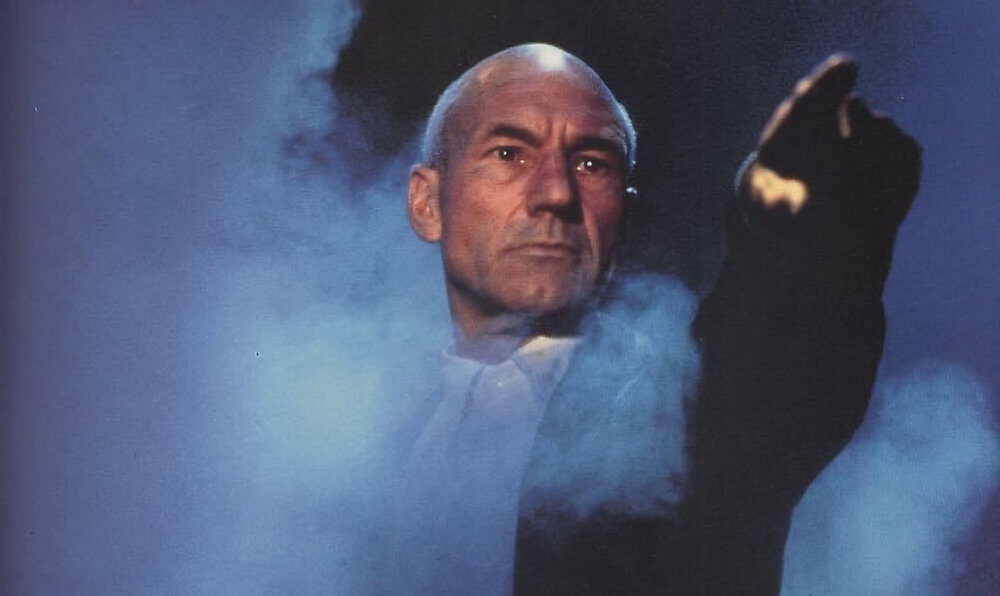
While Stewart ultimately won Olivier and Drama Desk Awards for “A Christmas Carol,” a poorly attended performance on an unseasonably cold Los Angeles night temporarily fractured his confidence. Only in retrospect did he fully understand the folly of soldiering on with the show in defiance of the Wadsworth Theatre’s malfunctioning heating system.
“With rising indignation, I said, ‘I would do the performance for one person if that’s all there was!’” Stewart wrote. “What a pompous ass.” Self-deprecating reflections were par for his cosmic course—even on a subject as personal as his affair with “Next Generation” co-star Jennifer Hetrick during his marriage to actress Sheila Falconer.
In “Making It So,” Stewart summed up his indiscretion ruefully and succinctly: “There was no way around it—I was cheating on my wife.” To this day, I’m struck by both the moral purity of Picard and the fraught humanity of the actor who played him. An actor who, I came to realize, owed us nothing and gave us everything.
Reading Stewart’s obituary in The New York Times, I was amused (or, to be more accurate, offended) by the piece’s take on Picard: that the character was “light years removed from his meatier roles” at the Royal Shakespeare Company, an elitist barb at odds with Stewart’s embrace of the character.
“I have been approached by so many strangers who freely confess to me that they endured difficult childhoods and that the one thing that they could hold on to—that pulled them through by giving them something to look forward to—was our show,” Stewart wrote. As someone still being pulled through a difficult adulthood by Picard, I can relate.
Last spring, I revisited “Star Trek: First Contact” (1996), the film in which a time-traveling Picard witnesses 21st century humans emerge from the ashes of a third World War. All his life, Picard has basked in the shade of a 24th century utopia; now, he sees it begin to take root.
“I envy you,” Lily (Alfre Woodard) tells Picard as he makes ready to return to his own time. “The world you’re going to.” “I envy you,” Picard replies gently. “Taking these first steps into a new frontier.” The next time I hear those words, I suspect I’ll weep even harder than I did the last.
There will be grief; there will be gratitude. Because right now, we’re all taking our first steps into a world that is without Patrick Stewart, yet forever shaped by his presence.