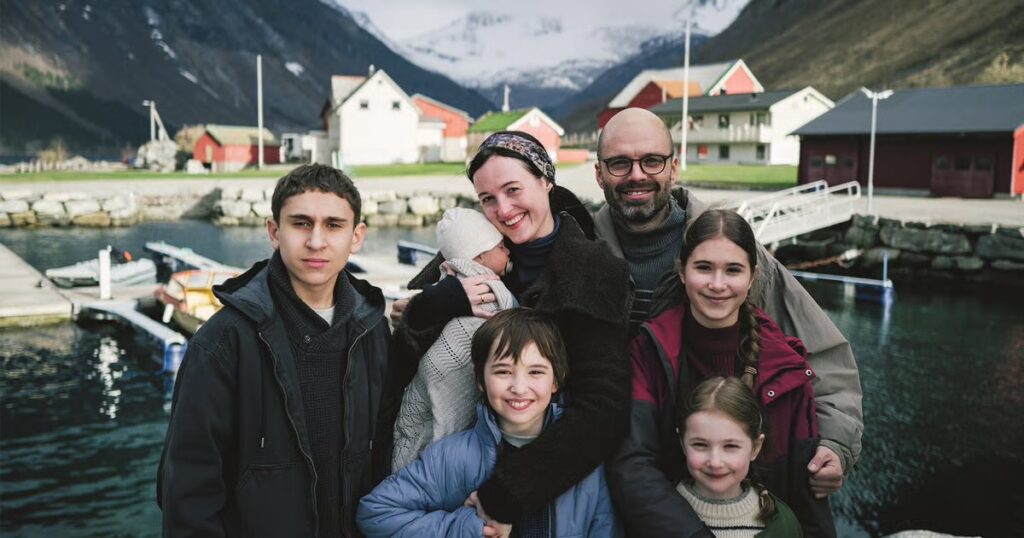
In Cristian Mungiu’s “Fjord,” the children of an evangelical Christian couple, Mihai (Sebastian Stan) and Lisbet (Renate Reinsve), are removed from their care by child protection services (on suspicions of physical abuse that will be intensely debated).
“Now I take over,” Mihai tells Lisbet as he swings an axe against a stump, declaring war on Norway’s secular bureaucracy. What happens next will confound any moviegoer who seeks to confine Mungiu (“4 Months, 3 Weeks and 2 Days”), that slippery auteur of the Romanian New Wave, to an ideological box.
Since seizing the Palme d’Or at the 2026 Cannes Film Festival, “Fjord” has become a culture-war curiosity, loathed by righteous liberals and lionized contrarian liberals. As if anticipating the explosive discourse, Mungiu enters Mihai and Lisbet’s lives like a soldier defusing a bomb: gingerly, thoughtfully, tenderly.
The first time we see Mihai, he faces Lisbet and their children, Elia (Vanessa Ceban) and Emmanuel (Jonathan Ciprian Breazu). “You need to admit when you’re wrong,” Mihai coldly tells Elia. The scene is insinuating without being damning, showing us just enough to make us wonder how much of Mihai’s cruelty Mungiu may be concealing.
For its first two acts, “Fjord” could be seen as a reactionary paean to devout underdogs defending their progeny from the influence of smartphones and wokeness. (When a character says that child protection services is “very powerful,” they sound like they’re describing the Galactic Empire from “Star Wars.”)
As word of Mihai and Lisbet’s struggle spreads, the nuances of “Fjord” deepen, despite the looming specter of MAGA-incubated Christian nationalism (Americans, we learn, have taken an interest in the couple’s case). Yet Mungiu is less interested in Trumpian bombast than he is in exposing the hypocrisy of parents and government officials alike who claim that they put children first.
When Elia and Emmanuel yearn to return to their parents, their wishes are ignored; when Mihai chooses their fate for them, their desires are dismissed. Apparently, the true divide is not between the family and the state, but between those who speak for children and those who listen to them (alarmingly few characters in the film fall into the latter category).
By the end of “Fjord,” Elia and Emmanuel are in danger of being whisked away from any who might truly hear them. Among the last words spoken in the film are “I love you” and “Be careful”—poignant sentiments in a story about youthful passion being suppressed by institutions and individuals who tragically mistake carefulness for love.