
Maybe it’s because I survived clumsily coming of age the year of “Inception” (2010); maybe it’s because I survived falling in and out of love the year of “The Dark Knight Rises” (2012); maybe it’s because I survived fearing for my life (and everyone else’s) the year of “Tenet” (2020).
Those, I grant you, are not journalistically defensible reasons for loving the films of Christopher Nolan, a director whose exultant creations have earned him two Oscars (for 2023’s “Oppenheimer”), a knighthood (bestowed by King Charles III), and the presidency (of the Directors Guild of America, but still). Nevertheless, they are my reasons.
Ask a Nolan acolyte why they adore his movies and they may recite a choice quote from his filmography. (A few personal favorites: “Why do we fall?” “I have to let you go.” “Survival’s not fair.”) Question them as ferociously as Batman does the Joker in “The Dark Knight” (2008), however, and they may tell you that, at some point in their lives, it was a Nolan film that got them through.
Arriving amid endless wars, fleeting joys, and the unnervingly frequent deployment of the phrase “the loneliness epidemic,” Nolan’s “The Odyssey” cannot be expected to get everyone through (no movie, not even one this magisterial, could). Still, Nolan valiantly does what he can, molding Homer’s epic poem into an epic film about a flawed hero—along with the generation he represents—“chasing the escaping sun.”
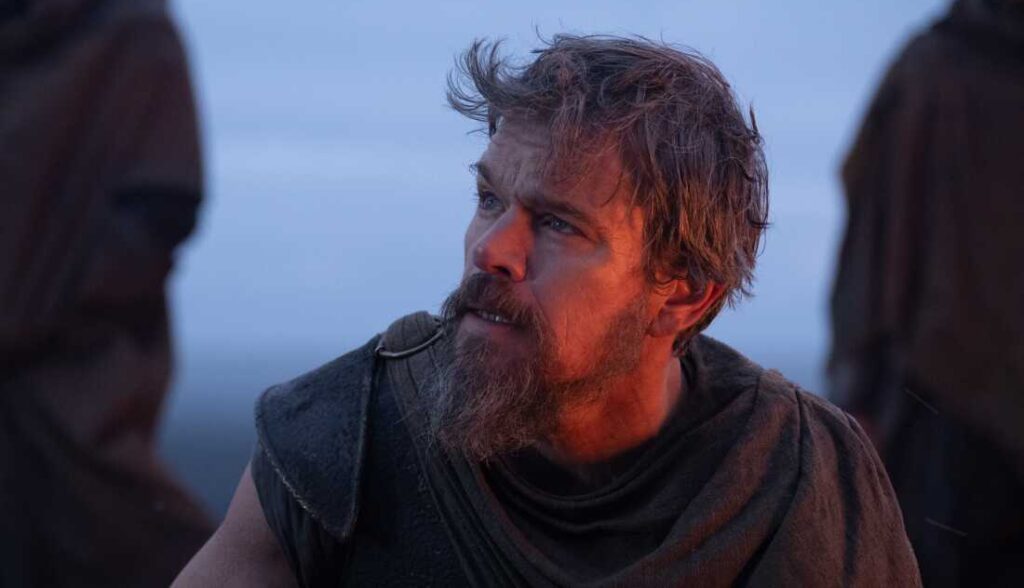
“Who has a story about Odysseus?” roars Menelaus (Jon Bernthal). “You, you have a story? Some say he’s rich or some say poor. Some say he perished, some say he’s imprisoned. What say you?” Says Nolan: Odysseus (Matt Damon) is the living embodiment of the trauma of our past and the promise of our future, tossed by an angry sea that will carry him to a luminous new world.
Just as Homer’s “Odyssey” was the forerunner of much modern storytelling, Odysseus was the forerunner of the Nolan protagonist. Like Cooper in “Interstellar” (2014), he is a father faced with a fraught homecoming; like J. Robert Oppenheimer, he is the father of a barbaric weapon; and like Leonard Shelby in “Memento” (2000), he is the father of his own disorientation, craving certainty, but fearing self-knowledge.
“I have a home somewhere,” Odysseus tells the placid nymph Calypso (Charlize Theron). Where, though? Following his triumph in the Trojan War, Odysseus is amnesia-stricken and adrift, immortalized in fading memory by distant loved ones as a tenacious warrior, a pragmatic husband, and a noble hunter (who plucked his bow to warn his prey).
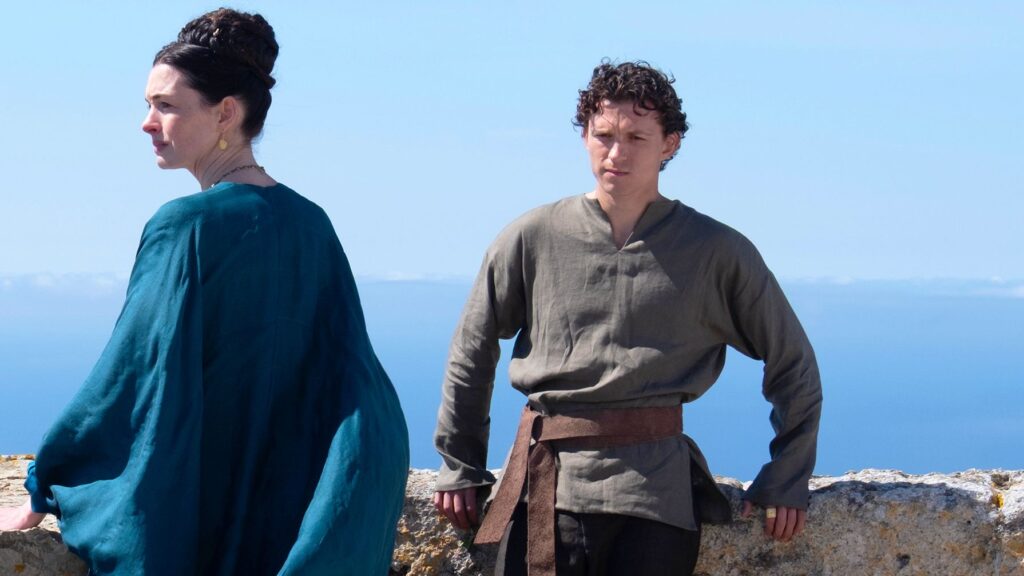
As Odysseus relates his existentially complicated hero’s journey to Calypso (cyclops, witch, clifftop tentacles, oh my!), the crystalline image of his younger self comes into focus: a stoic general departing a savaged Troy for beloved Ithaca, where his unyielding wife, Penelope (Anne Hathaway), and his self-willed son, Telemachus (Tom Holland), await.
“Ten years on this fucking beach,” Odysseus grouses to his men. “Let’s go home.” Drunk on the sight of an orange-red sail unfurling and the sound of Ludwig Göransson’s poignant score, it’s hard not to buy into Odysseus’ bravado, despite the gnawing wisdom we’ve gleaned from Nolan’s previous cinematic odysseys: that to return is to risk not recognizing either your home or yourself.
“Don’t walk in the front door expecting garlands and praise,” warns Agamemnon (Benny Safdie), who is mired in Hades. There, in black sand, lies proof that after a dalliance with the western in “Oppenheimer,” Nolan remains in the thrall of “The Searchers” (1956), John Ford’s chronicle of a man exiled from a civilization his savagery helped build.
In “Oppenheimer,” moral exile was signified by Oppenheimer quietly announcing, “I believe we did,” four words that unstoppered an apocalyptic montage: missiles launched, eyes skyward, fire greedily devouring the Earth’s atmosphere (images that Nolan artfully scattered throughout earlier scenes, priming them for a chilling convergence in the film’s final moments).
“Our film ends on what I think is a dramatically necessary note of despair,” Nolan said as he accepted the BAFTA Award for Best Director in 2024. “But in the real world, there are all kinds of individuals and organizations who have fought long and hard to reduce the number of nuclear weapons in the world.” As an artist, he had the luxury of being a pessimist; as a man, he decided to be an idealist.
In “The Odyssey,” Nolan renews his commitment to that choice. While Odysseus envisioned the Trojan Horse (effectively the atomic bomb of the Bronze Age), he is more forthright than the ethically shifty Oppenheimer, bearing his sins before a mesh doorway akin to a confessional screen (incidentally, or not, Nolan was raised Catholic).
“To burn the walls of Troy was to burn the world entire,” Odysseus says, remembering the sacking of Troy as a night of hellish heroism: labyrinthine streets, vengeful flames, and near-paralysis as he watched “10 years of rage pour into that city in one night.”
For all his eloquence, Odysseus is just one master storyteller in a crowded ensemble of raconteurs—including Eumaeus (John Leguizamo), Sinon (Elliot Page), and a bard (Travis Scott) whose bellowed distillation of the Trojan War (“A fleet! A war! A man! A thought! A trick!”) plays as a prelude to Odysseus embracing the narratives that painfully strengthen him over the ones that comfortably shield him.
“Maybe it’s time we all stopped trying to outsmart the truth and let it have its day,” Alfred (Michael Caine) declared in “The Dark Knight Rises,” another film about an armored veteran. Like Bruce Wayne, Odysseus can’t outsmart the truth of war; unlike Bruce Wayne, he lets divine punishment for his misdeeds wash over his weathered face.
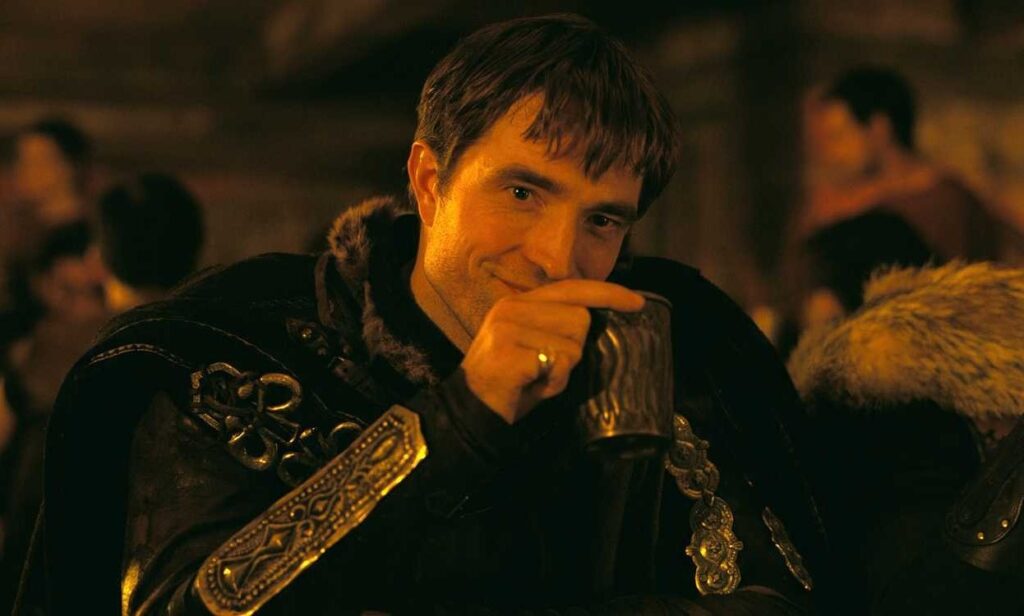
When the dream of Odysseus’ return is fulfilled, it brings a surge of pure Nolan showmanship: Odysseus’ rousing tribute to “the bravest young man I ever met” (whose identity is well, and pointedly, chosen), a cathartically brutal battle with Penelope’s vile suitors (led by Robert Pattinson’s mewling Antinous), a justly timed arrow to the throat (“You’re Odysse—!”).
“A new dawn will break over the darkening world,” Odysseus vows to Penelope. By now, he understands that he is too tarnished to herald that dawn himself, but his realization that the “age of bronze is collapsing” inspires him to put his faith in Telemachus and the days to come, rather than rage against the dying of old light.
Only those who have been tested can muster such strident optimism—and Nolan has been. The year he filmed “Inception,” he mourned his father; the year of “The Dark Knight Rises,” a gunman killed 12 people and injured 70 others at a screening of the film; the year of “Tenet,” Nolan insisted on releasing his movie mid-pandemic, leaving some fans (this one included) conflicted about his decision to privilege artistry over safety.
Perhaps I’m extrapolating a fluid story from choppy Nolan facts; if so, no matter. All you really need to know is that “The Odyssey,” like so many films by Christopher Nolan that came before, got me through.


One Response